
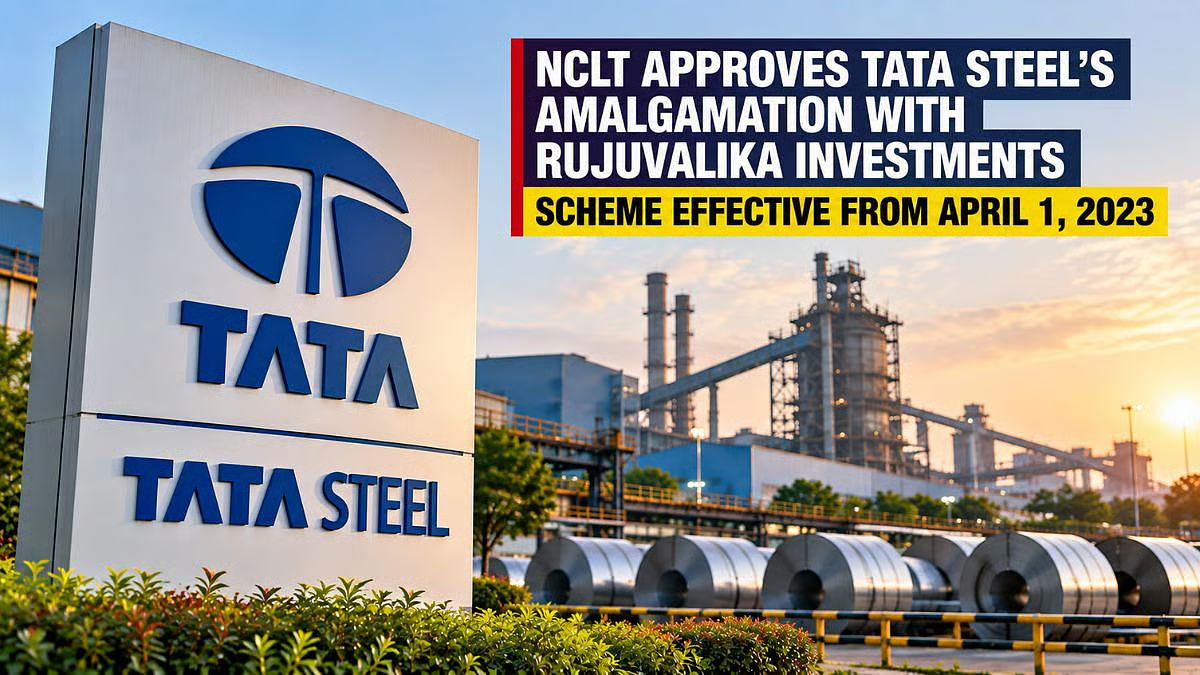
The Indian corporate sector ran an active subsidiary rationalisation calendar through 2025 and 2026, with Tata Group companies leading several such simplification exercises. The Tata Steel Rujuvalika Investments Amalgamation joined that list on October 1, 2026, when the National Company Law Tribunal (NCLT), Mumbai Bench, pronounced its order approving and sanctioning the scheme. Tata Steel Limited filed the BSE announcement under Regulation 30 of the Securities and Exchange Board of India (Listing Obligations and Disclosure Requirements) Regulations, 2015, at 21:01:34 on the same day.
This merger absorbs Rujuvalika Investments Limited, a wholly owned subsidiary of Tata Steel, into the parent company. The step forms part of a broader corporate structure cleanup that Tata Steel has pursued alongside its capacity expansion and global deleveraging strategy.
What Is the Tata Steel Rujuvalika Investments Amalgamation?
The Tata Steel Rujuvalika Investments Amalgamation is a scheme under Section 232 of the Companies Act, 2013, whereby Rujuvalika Investments Limited merges into its parent, Tata Steel Limited. Because Tata Steel owns 100% of Rujuvalika Investments, this qualifies as a wholly owned subsidiary (WOS) merger, a category that Indian courts and regulators treat with expedited procedures.
Under Indian corporate law, a WOS merger does not require a shareholder vote from the parent company’s public investors. The NCLT examines the scheme for compliance with statutory requirements and satisfies itself that the merger serves a legitimate business purpose. Upon the court’s approval, all assets, liabilities, contracts, employees, and rights of Rujuvalika Investments vest directly in Tata Steel Limited on the appointed date specified in the order.
Rujuvalika Investments Limited functions as an investment company within the Tata Steel group. It holds equity and debt investments in associate or group companies, providing a dedicated vehicle for managing the financial portfolio of the Tata Steel corporate family. The company is classified as a Non-Banking Financial Company (NBFC) registered with the Reserve Bank of India (RBI). Post-amalgamation, those investments consolidate directly into Tata Steel’s balance sheet.
NCLT Mumbai Sanctioned the Scheme on October 1, 2026
The Hon’ble NCLT, Mumbai Bench pronounced its order approving and sanctioning the Tata Steel Rujuvalika Investments Amalgamation on October 1, 2026. Tata Steel filed the outcome with BSE under the Scheme of Arrangement category, referencing Regulation 30 (LODR). The exchange recorded the filing at 21:01:34 IST.
The NCLT process for corporate mergers under Section 232 of the Companies Act, 2013 typically proceeds in stages: petition filing, admission of the petition, directions for meetings of creditors and members, hearing on the scheme, and final order. In WOS mergers, the NCLT generally dispenses with the creditors’ and members’ meetings where the scheme carries no adverse impact on any stakeholder class.
Tata Steel published a newspaper advertisement on August 11, 2026, notifying the public of the hearing of the Company Scheme Petition before the NCLT Mumbai Bench. This advertisement signals that NCLT had already admitted the petition by that stage and scheduled a hearing. The court then moved toward final order by October 1, completing a timeline of approximately two months from public notice to approval.
The scheme was filed with BSE under LODR Regulation 30, and investors can access the original order document in the 0.74 MB filing linked to the October 1, 2026 announcement.
Scheme Timeline: Key Milestones from Petition to NCLT Order
The Tata Steel Rujuvalika Investments Amalgamation followed the standard regulatory pathway for WOS mergers in India. The table below captures the known milestones across the scheme’s lifecycle.
| Milestone | Date | Regulatory / Procedural Basis |
|---|---|---|
| Board Approval of Scheme | FY2026 (exact date not disclosed) | Section 230/232, Companies Act 2013 |
| NCLT Mumbai Petition Filed | FY2026 (exact date not disclosed) | NCLT (Procedure for Reduction of Share Capital) Rules |
| Newspaper Hearing Advertisement | August 11, 2026 | NCLT rules, public notice requirement |
| NCLT Mumbai Hearing Period | August-September 2026 | NCLT Mumbai Bench proceedings |
| NCLT Order Pronouncing Sanction | October 1, 2026 | Section 232(3), Companies Act 2013 |
| BSE Announcement (Regulation 30) | October 1, 2026 (21:01 IST) | SEBI LODR Regulation 30 disclosure |
| Effective Date (Vesting of Assets) | Per NCLT appointed date | Date specified in NCLT order |
Source: BSE corporate announcements for Tata Steel Limited (BSE code 500470), accessed October 2026.
Rujuvalika Investments’ Role Inside Tata Steel’s Corporate Architecture
Tata Steel operates a multi-layered corporate structure spanning India, Europe, and Southeast Asia. Its key disclosed subsidiaries include Tata Steel UK Limited, Tata Steel Netherlands (formerly Tata Steel Europe’s Dutch arm), and Tata Steel Thailand. Beyond manufacturing entities, the group maintains investment holding companies that historically served as conduits for intra-group financial flows.
Rujuvalika Investments Limited sits in the investment-holding tier. As an NBFC, it operates under RBI oversight and holds financial instruments rather than manufacturing assets. The amalgamation eliminates that intermediate layer, allowing Tata Steel to manage investments directly without operating a separate regulated NBFC entity. This removes the dual compliance burden of maintaining both a listed parent’s reporting requirements and an NBFC’s RBI regulatory submissions.
Tata Steel’s management has pursued subsidiary rationalisation alongside its core operational strategy. The company approved a steelmaking capacity expansion of 4.8 million tonnes per annum (MTPA) at its NINL (Neelachal Ispat Nigam Limited) subsidiary, involving capital expenditure of Rs. 33,873 crore. At the same time, it divested its entire stake in Jamshedpur Football and Sporting Private Limited in 2025-2026. On September 29, 2026, Tata Steel also announced the acquisition of equity shares in T Steel Holdings Pte. Ltd., a Singapore-based entity. These moves together illustrate a corporate strategy that simultaneously builds core steel assets, exits non-core holdings, and simplifies the holding structure.
Why WOS Mergers Generate Value for Parent Companies

The Tata Steel Rujuvalika Investments Amalgamation delivers four quantifiable benefits to Tata Steel’s business operations and compliance workload.
Administrative cost savings. Maintaining a registered NBFC requires annual audited financial statements, RBI filings, board meetings, and secretarial compliance under the Companies Act. Eliminating the subsidiary removes this recurring cost permanently.
Balance sheet transparency. When Rujuvalika’s investment portfolio consolidates directly into Tata Steel’s books, analysts and investors read a simpler consolidated statement. Intercompany eliminations reduce, and the parent’s true economic asset base becomes easier to evaluate.
Capital efficiency. Investments held at the subsidiary level often carry a valuation layer that differs from the parent’s carrying value. Direct ownership removes this layer and allows Tata Steel’s treasury to manage those assets without the frictional oversight of a separate board and management.
NBFC de-registration. Following the merger, Tata Steel will surrender Rujuvalika Investments’ NBFC registration with the RBI. This eliminates the regulatory risk of an NBFC subsidiary inadvertently triggering capital adequacy or exposure norms that could constrain the broader group’s financial flexibility.
Tata Steel’s Financial Standing and Stock Market Context
Tata Steel Limited closed at Rs. 178.00 on BSE (code 500470) and NSE (TATASTEEL) on October 1, 2026, the same day the NCLT order came through. The stock fell Rs. 6.30 (-3.42%) on the day, reflecting broader market weakness rather than any scheme-specific sentiment, as the Nifty 50 itself dropped 1.34% in the same session.
For the financial year ended March 31, 2025, Tata Steel reported consolidated revenue of Rs. 2,20,083 crore (approximately US$23 billion), making it one of India’s largest listed companies by top-line. Net income for FY2025 stood at Rs. 3,174 crore. Total assets reached Rs. 2,79,395 crore and total equity Rs. 91,353 crore. The company ranks eighth globally in crude steel output, with annual capacity of 35 million tonnes and production of 31.02 million tonnes.
The 52-week trading range for Tata Steel on NSE spans a low of Rs. 160.06 (December 9, 2025) to a high of Rs. 224.40 (May 15, 2026). At Rs. 178, the stock carries a Price/Earnings ratio of 19.73 and a market capitalisation of approximately Rs. 2,22,207 crore. Investors interested in comparing broader corporate action trends in Indian steel and manufacturing IPOs can read about related Tata Group corporate events in the IPO GMP and corporate action tracker on ipocontrol.in.
What Shareholders Should Monitor After NCLT Sanction
The Tata Steel Rujuvalika Investments Amalgamation does not change the equity capital of Tata Steel Limited. No new shares issue for the merger since Rujuvalika is a wholly owned entity. The appointed date (effective date) in the NCLT order determines when Rujuvalika’s assets and liabilities formally transfer.
Shareholders should watch for two subsequent filings. First, Tata Steel will notify BSE and NSE once the merger becomes effective, with the appointed date confirmed. Second, the company’s next set of quarterly results (Q2 FY2026 or Q3 FY2026, depending on timing) will reflect Rujuvalika’s former investment portfolio directly in Tata Steel’s standalone balance sheet.
The structural impact of the Tata Steel Rujuvalika Investments Amalgamation is administrative rather than financial. Revenue, EBITDA, and net profit at the consolidated level will see no material change since Rujuvalika’s results were already captured in Tata Steel’s consolidated accounts. The practical effect falls at the standalone and subsidiary count levels.
For tracking the Regulation 30 announcement and any follow-up disclosures, investors can monitor Tata Steel’s corporate announcements page at NSE India (TATASTEEL) and the SEBI LODR circular framework that governs disclosure timelines.
Frequently Asked Questions on the Tata Steel Rujuvalika Investments Amalgamation
What is Rujuvalika Investments Limited? Rujuvalika Investments Limited is a wholly owned subsidiary of Tata Steel Limited, classified as an NBFC registered with the Reserve Bank of India. It holds equity and debt investments on behalf of the Tata Steel group. The company carries no independent public listing on NSE or BSE.
How does the NCLT process work for a WOS merger? Under Section 232 of the Companies Act, 2013, a company files a scheme petition before the NCLT bench with jurisdiction. The tribunal reviews compliance, may dispense with creditor/member meetings for wholly owned subsidiary mergers, advertises the hearing, holds the proceeding, and pronounces a final order. The October 1, 2026 NCLT order marks the completion of that process for this scheme.
Does the Tata Steel Rujuvalika Investments Amalgamation require any shareholder vote? No. Because Rujuvalika Investments is 100% owned by Tata Steel, the scheme does not require approval from Tata Steel’s public shareholders. The NCLT, not the general meeting, provides the legal sanction needed under the Companies Act.
Will the merger change Tata Steel’s share count or the dividend policy? No new shares issue as a result of this scheme. Tata Steel’s share count and existing dividend policy remain unchanged. The merger consolidates Rujuvalika’s investment assets directly into Tata Steel’s standalone books without altering capital structure.
Where can investors get post-merger updates once the Tata Steel Rujuvalika Investments Amalgamation effective date is notified? Investors should monitor the Tata Steel corporate announcements section on BSE India (code 500470) and NSE. The company will file the effective date notification once Rujuvalika’s assets formally transfer under the NCLT order’s appointed date. SEBI’s LODR framework requires this disclosure within 24 hours of the event.
Disclaimer: This article is for educational and informational purposes only. It does not constitute investment advice. ipocontrol.in is not registered with SEBI as an investment adviser. Investors should consult a SEBI-registered financial adviser before making investment decisions.