
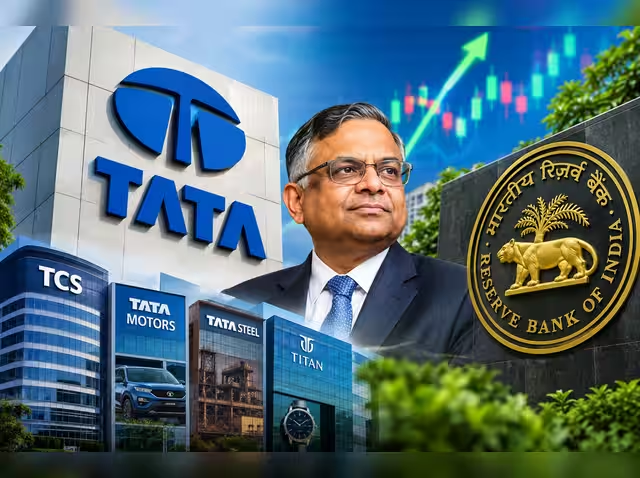
Tata Sons Private Limited is the principal holding company of the Tata Group, India’s largest conglomerate by consolidated revenue, and the entity that controls stakes in Tata Consultancy Services (TCS), Tata Steel, Tata Motors, Tata Power, and roughly 30 other listed and unlisted businesses. The Tata Sons IPO — a potential public listing of this holding company on the National Stock Exchange (NSE) or Bombay Stock Exchange (BSE) — does not carry a confirmed date, price band, or issue size in September 2026. This article explains why the listing question arose, what Tata Sons has done to sidestep the regulatory requirement, what the valuation would look like if the IPO proceeds, and what investors should monitor through the rest of the year.
The Tata Sons IPO story is driven entirely by a regulatory trigger, not a voluntary decision to raise capital. The Reserve Bank of India (RBI) classified Tata Sons as an upper-layer Non-Banking Financial Company (NBFC) under its scale-based regulation (SBR) framework in September 2022. Under RBI rules, upper-layer NBFCs that access public funds face a mandatory stock exchange listing requirement within three years of that classification. That three-year deadline pointed to September 2025, turning a private family holding company into a subject of intense capital market discussion across India.
Why Tata Sons Holds Upper-Layer NBFC Status and What That Classification Requires
The RBI introduced its scale-based regulation framework for NBFCs through a circular in October 2021, creating four tiers: Base Layer, Middle Layer, Upper Layer, and Top Layer. The Upper Layer identifies the ten most systemically significant NBFCs in India each year, selected based on total asset size, interconnectedness with the financial system, and access to public funds. Tata Sons qualifies as a Core Investment Company (CIC) — an NBFC that primarily holds investments in group companies rather than conducting lending operations. Its CIC status, combined with its historically large borrowing programme through publicly placed Non-Convertible Debentures (NCDs), placed it squarely in the upper-layer category from the moment RBI applied the classification in 2022.
The mandatory listing requirement under the SBR framework exists for a clear regulatory reason. When an upper-layer NBFC accesses public funds — whether through NCDs subscribed by retail investors, institutional investors, or public financial institutions — those investors acquire a financial stake in an entity whose health affects the broader financial system. The RBI’s position is that organisations of this size and systemic importance must accept the disclosure standards, governance obligations, and ongoing SEBI compliance that comes with being a publicly listed entity. Tata Sons, with stakes across virtually every major Indian industry and a consolidated group revenue approaching ₹4 lakh crore, fits that systemic significance description precisely.
How Tata Sons Has Tried to Exit the Mandatory Listing Requirement
Tata Sons responded to the RBI’s upper-layer classification with a deliberate liability restructuring strategy. In FY2024, the company repaid all outstanding NCDs — removing its public fund borrowings from its balance sheet entirely. With no public-placed debt instruments outstanding, Tata Sons argued to the RBI that it no longer accessed public funds and therefore should not remain classified as a public-facing upper-layer NBFC subject to the mandatory listing requirement. The company subsequently applied to the RBI to surrender its Core Investment Company registration under the public NBFC category and be reclassified as a private CIC that neither accepts deposits nor accesses public capital markets for debt.
The RBI’s response to this application became the central variable determining whether the Tata Sons IPO expected date would materialise at all. Tata Sons’ position is legally argued: the SBR framework’s listing requirement attaches specifically to public fund access, and without outstanding public borrowings, the basis for mandatory listing dissolves. The RBI’s position — still under evaluation as of mid-2026 — is that systemic importance does not disappear simply because borrowings are repaid, and the classification may survive the restructuring. The outcome of this regulatory standoff determines whether Tata Sons files a DRHP with SEBI in 2026-2027 or continues as a private entity indefinitely.
Tata Sons IPO Valuation Estimate: The Numbers That Would Reshape Indian Markets
A Tata Sons IPO, if it proceeds, would rank among the two or three largest public listings in Indian capital market history, alongside LIC’s FY2022 IPO which raised ₹20,557 crore and listed with a market capitalisation exceeding ₹6 lakh crore. Investment bankers and analysts who have estimated Tata Sons’ intrinsic value arrive at a range of approximately ₹14 lakh crore to ₹18 lakh crore on a pre-discount sum-of-parts (SOTP) basis. The dominant component of that value is Tata Sons’ approximately 72.4% stake in TCS — India’s most valuable company by market capitalisation, which has maintained a market cap in the ₹13-15 lakh crore range through FY2025-FY2026. Tata Sons’ TCS holding alone represents approximately ₹9.5-10.8 lakh crore of intrinsic value at current prices.
Beyond TCS, the Tata Sons IPO SOTP valuation must account for stakes across the rest of the group: approximately 33% in Tata Steel (market cap ~₹1.5 lakh crore), approximately 38% in Tata Motors (market cap ~₹2.8-3.2 lakh crore), approximately 46% in Tata Power, approximately 38% in Indian Hotels Company (IHCL), and meaningful positions in Tata Consumer Products, Titan Company, and Tata Communications. Holding company discounts of 20-40% are standard in Indian markets — investors pay less for a holding company than the sum of its parts because of governance opacity, illiquidity at the holding layer, and uncertainty about when or whether the holding company will distribute value. After applying a 25-35% discount, the implied Tata Sons IPO listing valuation range would be approximately ₹9.5-12.5 lakh crore, still large enough to make it a top-five company by market cap from day one of trading.
Tata Sons’ standalone financials — the holding company’s own profit and loss, excluding subsidiaries — reflect primarily the dividends received from group companies. TCS alone paid dividends of approximately ₹36,000 crore to all shareholders in FY2025, with Tata Sons receiving its 72.4% proportionate share. This dividend income forms the core of Tata Sons’ standalone revenue and sustains its operations, debt service, and the dividends Tata Sons in turn pays to the Tata Trusts and Shapoorji Pallonji Group as major shareholders.
Tata Sons vs Other Indian Listed Holding Companies: A Scale That Has No Comparison
To appreciate what a Tata Sons IPO would mean for Indian capital markets, a comparison with existing listed holding companies is useful. India has a small category of publicly traded investment holding companies, but none approaches the scale of what Tata Sons would bring.
| Holding Company | Listed | Key Underlying Stakes | Estimated Market Cap / Value (₹ Cr) | Typical HoldCo Discount |
|---|---|---|---|---|
| Tata Sons Private Limited | No (unlisted) | TCS 72.4%, Tata Steel 33%, Tata Motors 38%, Tata Power 46% | ₹9.5-12.5 lakh crore (est.) | N/A — unlisted |
| Bajaj Holdings & Investment | Yes (BSE: 500490) | Bajaj Auto, Bajaj Finserv, Bajaj Finance | ~₹1.1-1.3 lakh crore | 35-45% |
| Godrej Industries | Yes (BSE: 500166) | Godrej Consumer, Godrej Properties, Godrej Agrovet | ~₹25,000-35,000 crore | 30-40% |
| JSW Holdings | Yes (BSE: 532642) | JSW Steel, JSW Energy | ~₹18,000-22,000 crore | 40-55% |
| Pilani Investment & Industries | Yes (BSE: 500334) | Hindalco, Grasim, Aditya Birla Group cos. | ~₹3,500-5,000 crore | 50-65% |
The table illustrates why this conversation matters so much to Indian capital markets. Bajaj Holdings — the most actively tracked listed holding company in India — has a market cap approximately 10 times smaller than the most conservative Tata Sons estimate. For investors already familiar with large-cap listings, the Tata Motors share price analysis and demerger update provides useful context on how Tata Group companies are currently valued at the operating company level.
Tata Sons IPO Date and Latest News: Where Things Stand in September 2026
The Tata Sons IPO date remains unconfirmed as of September 2026. No Draft Red Herring Prospectus (DRHP) has been filed at sebi.gov.in, no book running lead managers or registrars have been publicly appointed, and no roadshow schedule or subscription window has been announced. N Chandrasekaran, Chairman of Tata Sons since February 2017, has consistently declined to commit to listing timelines in public statements and earnings discussions at listed Tata Group companies.
Tata Sons IPO latest news in 2026 centres on two regulatory events. First, the RBI publishes its annual updated list of upper-layer NBFCs each September — this single notification will either include Tata Sons (maintaining pressure for listing) or remove it (potentially resolving the regulatory mandate). Second, any SEBI notification of a DRHP filing by Tata Sons would appear at sebi.gov.in within hours of submission and would be simultaneously uploaded to nseindia.com and bseindia.com. Both portals carry DRHP filings under their capital market/primary market sections.
The Shapoorji Pallonji (SP) Group holds approximately 18.4% of Tata Sons — a stake that has been the subject of legal and financial dispute since the Cyrus Mistry boardroom exit in 2016 and subsequent NCLT and Supreme Court proceedings. SP Group has previously sought liquidity options for this holding. A public listing would provide the most straightforward exit or monetisation mechanism for the SP Group’s 18.4%, making the group a quiet but persistent stakeholder interest in favour of eventual listing. The Tata Trusts — comprising the Sir Dorabji Tata Trust and the Sir Ratan Tata Trust, which together hold approximately 66% of Tata Sons — retain effective control over any listing decision and have historically prioritised group stewardship over liquidity events.
What Retail and Institutional Investors Must Know Before the IPO Becomes Real
Any confirmed Tata Sons IPO would proceed through a SEBI-regulated book-built issue process. Investor categories would follow the standard SEBI allocation framework: Qualified Institutional Buyers (QIB) receiving at least 50% of the issue, Non-Institutional Investors (NII/HNI) receiving 15%, and Retail Individual Investors (RII) receiving 35%. Given the anticipated scale of the issue, QIB demand from domestic mutual funds, Foreign Institutional Investors (FIIs), and sovereign wealth funds would likely determine price discovery, with retail allocation becoming available only after institutional anchor and book-building portions close.
Retail investors should resist the temptation to purchase “unlisted Tata Sons shares” through informal platforms before a DRHP is filed and SEBI approves the issue. Grey market activity in unlisted shares of private companies carries significant risks — no SEBI oversight, no transparent pricing mechanism, and no guaranteed liquidity. The correct trigger for retail investor action is a confirmed SEBI-approved prospectus and a scheduled subscription window from a SEBI-registered registrar. Live SEBI filings and prospectus documents are available at sebi.gov.in and financial news sources including Moneycontrol and Economic Times, which carry DRHP announcements immediately upon SEBI receipt.
Frequently Asked Questions
Q1: What is the current status of the Tata Sons IPO as of 2026? The Tata Sons IPO has not been confirmed as of September 2026. No DRHP has been filed with SEBI, and Tata Sons management has not publicly committed to a listing timeline. The regulatory outcome of Tata Sons’ application to surrender its upper-layer NBFC classification with the RBI is the primary determinant of whether an IPO materialises.
Q2: Can retail investors apply for Tata Sons shares today? No. Tata Sons Private Limited is fully unlisted and does not trade on NSE or BSE. No regulated application process exists for retail investors. Platforms offering “unlisted Tata Sons shares” operate outside SEBI oversight, and investors using them accept substantial liquidity, valuation, and fraud risk. Retail investors should wait for a confirmed SEBI-approved IPO prospectus before taking any action.
Q3: How does the RBI’s upper-layer NBFC rule force a company to list? Under the RBI’s scale-based regulation (SBR) framework, upper-layer NBFCs that access public funds must list on a SEBI-recognised stock exchange within three years of classification. The rule is designed to impose transparency and continuous disclosure on systemically significant financial entities. The RBI identifies upper-layer NBFCs annually and publishes the list through official circulars at rbi.org.in.
Q4: What would the Tata Sons IPO valuation be at listing? Analysts estimate an implied listing valuation of approximately ₹9.5-12.5 lakh crore after applying a standard 25-35% holding company discount to the sum-of-parts value. The pre-discount SOTP range sits at approximately ₹14-18 lakh crore, with Tata Sons’ 72.4% stake in TCS representing the dominant value component at approximately ₹9.5-10.8 lakh crore alone.
Q5: Does Shapoorji Pallonji Group’s 18.4% stake influence the listing timeline? The SP Group has previously sought liquidity options for its Tata Sons holding, and a public listing is the most natural mechanism to achieve that. However, the Tata Trusts hold approximately 66% and exercise effective control over group decisions. Any listing requires board and shareholder approval at Tata Sons — where the Tata Trusts, not SP Group, hold the decisive vote. SP Group’s interest adds context to the discussion but does not independently drive the timeline.
The Bigger Picture: Why the Tata Sons IPO Question Will Not Disappear
The Tata Sons IPO story is unique in Indian capital markets because it involves not a company seeking growth capital but a sovereign-scale holding company being pushed toward public accountability by a financial regulator. The RBI’s upper-layer NBFC framework was designed precisely for organisations so large and interconnected that their opacity represents a systemic risk, regardless of whether they borrow from the public at the moment of classification. Tata Sons’ strategy of repaying NCDs to exit the mandatory listing requirement is legally argued and may succeed — but the regulatory conversation it has triggered will shape how India’s CIC framework applies to other large private holding companies for years.
For investors, the outcome matters at two levels. If the RBI rejects the deregistration and Tata Sons files a DRHP, Indian retail investors gain their first opportunity to own a fractional interest in the holding entity behind TCS, Tata Steel, Tata Motors, and the broader Tata Group ecosystem. If Tata Sons successfully exits the mandatory listing route, the company remains private, and the valuation unlock that a listing would bring stays locked inside the Tata Trusts’ charitable structure. Either outcome resolves one of the most watched regulatory and corporate governance questions in India — and tracking the RBI’s September NBFC list announcement and SEBI’s DRHP portal in parallel gives investors the earliest reliable signal of which way this resolves.
Disclaimer: This article is for informational and educational purposes only. It does not constitute investment advice or a recommendation to buy, sell, or hold any security. This site is not registered with SEBI as an investment advisor. Consult a SEBI-registered financial advisor before making any investment decisions.