
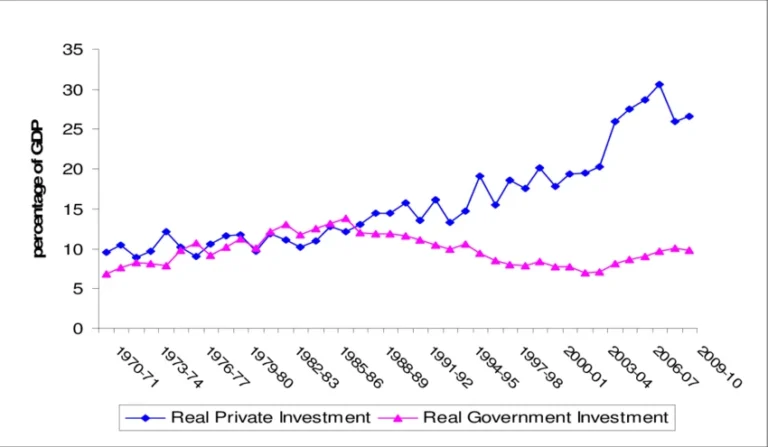
168 Indian companies are now spending over ₹1,000 crore each on capacity expansion — the highest count since 2012, and the clearest proof that private investment in India has stopped waiting for government signals and started moving on its own terms.
Combined capital outlay from listed companies, central government, and state governments is projected at ₹32 lakh crore in FY2026, with private sector contribution rising 21.5% to ₹2.67 lakh crore according to an RBI study — numbers that directly shape which sectors, IPOs, and equity themes deliver returns for Indian retail investors over the next three to five years.
What Is Private Investment in India and Why Does It Drive Stock Market Returns?
Private investment in India refers to capital deployed by corporations and businesses — not the government — to build factories, data centres, refineries, and infrastructure that generate future output. Unlike government capex funded through tax revenues and borrowings, private investment responds directly to demand signals, profit expectations, and credit availability.
Corporate capital expenditure drives revenue growth, EPS expansion, job creation, and sector-wide earnings upgrades — the backbone of equity market re-ratings across entire industries. A sustained multi-year capex upcycle in India has historically produced a 3–5-year window of above-average equity returns in manufacturing, infrastructure, and capital goods sectors.
Two distinct types exist: brownfield investment (expanding existing plants and facilities) and greenfield investment (new factories, semiconductor fabs, data centres). Greenfield projects carry the more powerful economic signal — they indicate corporate conviction over a 5–10-year demand horizon, not simply capacity optimisation.
Private Investment in India 2026 — Key Numbers Every Investor Must Know
The scale behind private investment in India in FY2026 represents the most concentrated burst of corporate capital deployment since the infrastructure boom of 2007–2012. Listed Indian companies are projected to spend ₹12.6 lakh crore on capital expenditure this fiscal year, up 11% from FY25, and when combined with central and state government capex, the total investment pool reaches ₹32 lakh crore.
CMIE Prowess data shows private capex rising 67% year-on-year — from ₹4.6 lakh crore in September 2024 to ₹7.7 lakh crore in September 2025. Industrial credit from banks to industry grew 19.2% year-on-year in June 2026, sharply up from 6.3% the prior year — the most direct bank-level confirmation of corporate borrowing for capacity creation.
| Metric | Value | Period |
|---|---|---|
| Listed company capex projection | ₹12.6 lakh crore | FY2026 |
| Total combined capex (listed + central + state) | ₹32 lakh crore | FY2026 |
| Private sector capex (RBI estimate) | ₹2.67 lakh crore | FY2026 |
| YoY private capex growth (RBI) | +21.5% | FY26 vs FY25 |
| Industrial credit growth YoY | +19.2% | June 2026 |
| Companies spending >₹1,000 Cr annually | 168 | FY26 (highest since 2012) |
| PLI scheme total approved investment | ₹2.16 lakh crore | As of 2026 |
| Semicon India Programme approved investment | ₹1.6 lakh crore | 10 units approved |
An RBI study estimates private corporate investment will surge 54% over the medium term, anchoring the bull case for capital goods, engineering, and infrastructure equity themes. Manufacturing alone accounts for over 50% of total private capex in FY26, with the share moderating to approximately 44% in FY27 as semiconductors and data centres scale.
Six Sectors Benefiting from Private Investment in India’s 2026 Capex Wave
The breadth of this cycle sets it apart from earlier revivals — private sector investment in India 2026 spans six distinct sectors rather than concentrating in one or two.
Manufacturing — the Largest Share
Manufacturing accounts for over 50% of total private capex in FY26, led by the PLI scheme across 14 sectors that has generated ₹2.16 lakh crore in cumulative investment and 14.39 lakh jobs as of 2026. The Jio Platforms IPO — which raised ₹37,700 crore as a 100% fresh issue to fund telecom infrastructure — illustrates how large-scale private capital deployment flows directly through India’s equity markets into capacity creation.
Semiconductors and Electronics — the Fastest Growing
The Semicon India Programme has 10 approved units — silicon fab, silicon carbide fab, advanced packaging, and memory packaging — with total committed investment of ₹1.6 lakh crore. Four additional units received Union Cabinet approval in Odisha, Punjab, and Andhra Pradesh in 2026, with India targeting a top-4 global semiconductor manufacturing position by 2035.
Renewable Energy and Power
The power sector leads infrastructure capex, with greenfield renewable energy investment in solar, wind, and green hydrogen attracting the fastest sub-sector growth in FY26. Renewable capex functions as both a macroeconomic private investment signal and a listed equity theme accessible through clean energy IPOs and power sector stocks on NSE and BSE.
Data Centres and Digital Infrastructure
Greenfield data centre projects are increasingly driving industrial credit demand, with hyperscaler investment from global and domestic players accelerating through FY26. Investors tracking AI and digital investment themes shaping India’s markets in 2026 will recognise data centres as one of the fastest-moving private capex sub-sectors in the country.
Infrastructure — Roads, Ports, Logistics
The National Infrastructure Pipeline has catalysed ₹111 lakh crore in planned projects, with private sector participation rising through hybrid annuity and toll-operate-transfer models. Logistics and warehousing companies benefit as a second-order effect — manufacturing capex drives demand for movement, storage, and last-mile distribution.
Real Estate and Commercial Property
Commercial real estate and hospitality are seeing renewed greenfield investment as India’s services workforce expands and large enterprises build physical footprints. Residential real estate private capex is also accelerating, with major developers deploying expanded capital in Tier 1 and Tier 2 cities.
Four Policy Levers That Unlocked the Private Investment in India Revival
The current private investment in India revival did not emerge spontaneously — it rests on a policy architecture assembled across five years, with four mechanisms doing the heaviest lifting.
The PLI scheme offers ₹1.97 lakh crore in approved outlay across 14 sectors, structured as a revenue-linked subsidy that eliminates upfront policy uncertainty and gives companies a defined return framework before committing to capital expenditure. Make in India and Atmanirbhar Bharat created the demand signal for global supply chain relocation out of China, with Apple’s supplier ecosystem expansion in Tamil Nadu and Andhra Pradesh the most widely cited example.
The National Infrastructure Pipeline’s ₹111 lakh crore in planned projects provides the demand visibility that triggers private logistics and port capex adjacent to public infrastructure builds. RBI’s cumulative 100 basis point rate cut directly improves project internal rates of return, making long-gestation greenfield projects economically viable at lower hurdle rates — a direct stimulant to FDI-backed private capex announcements.
Government Capex vs Private Sector Capital Expenditure India — How FY26 Marks a Structural Shift
For the first time since 2012, private investment in India is growing faster than government capex — and the data below captures where the balance has moved.
| Parameter | FY2024 | FY2025 | FY2026 |
|---|---|---|---|
| Central Government Capex (₹ lakh crore) | ₹9.5 | ₹10.18 | ₹11.11 (BE) |
| State Government Capex (est.) | ~₹8.0 | ~₹8.5 | ~₹9.0 |
| Listed Company Capex (₹ lakh crore) | ~₹9.6 | ~₹11.0 | ₹12.6 |
| Private Capex YoY Growth | ~8% | ~10% | ~21.5% (RBI est.) |
| Industrial Credit Growth YoY | ~7% | ~8% | 19.2% (June 2026) |
| Companies Spending >₹1,000 Cr annually | ~140 | ~155 | 168 (highest since 2012) |

The acceleration in industrial credit (19.2%) alongside the rising company-level count (168 companies spending >₹1,000 crore annually) confirms the signal is broad-based, not concentrated in a few large conglomerates. FY26 is the first year where private capex growth at 21.5% meaningfully outpaces the government’s own capital expenditure growth — a structural inflection, not a statistical blip.
How Retail Investors Can Track and Profit from Private Investment in India
Retail investors do not need to own individual capex stocks to benefit from private investment in India — the more durable approach is reading the macro signals before they are priced into equities. PLI-linked sector ETFs and manufacturing-focused mutual funds provide diversified exposure to the private sector capital expenditure India upswing without the concentration risk of individual stock selection.
IPO DRHP analysis is one of the most under-used tracking tools available to retail investors: when a company’s use of proceeds allocates capital to machinery, plant construction, or new facilities, that IPO directly expresses private capex conviction at the company level. SEBI mandates full use-of-proceeds disclosure in every DRHP filed with the NSE and BSE — publicly accessible data that most retail investors do not read.
RBI’s monthly bank credit to industry report leads capital goods equity performance by 1–2 quarters; sustained growth above 15% in industrial credit has historically been the buy signal for manufacturing and engineering stocks. CMIE Prowess tracks forward-looking investment announcements 6–12 months before actual capex materialises, giving investors early visibility on which sectors India investment growth 2026 will flow into next.
Five Risks That Could Slow India’s Private Capex Growth 2026
These five risks are specific to the current cycle — not generic market warnings.
Global demand shock: India’s manufacturing capex assumes export growth; US tariff escalation or a global recession directly reduces export-facing investment viability and can force deferral of PLI-linked committed projects. This risk carries highest weight for electronics and pharmaceutical capex with confirmed export targets.
Domestic demand compression: Capacity utilisation rates trigger new capex commitments; sustained food inflation or a consumption slowdown reduces utilisation below the 80–85% threshold at which companies historically expand. Consumer-facing manufacturing is the most exposed sub-sector.
Credit cost reversal: If inflation rebounds and forces RBI to reverse its rate cuts, project IRRs compress and corporate capex that was viable at lower rates turns marginal. Industrial credit growth could decelerate sharply from the current 19.2% if benchmark rates move higher.
PLI execution risk: PLI disbursements are contingent on production targets — companies that miss thresholds lose the incentive, making prior capex commitments uneconomical. Q1 FY26 showed a sharp fall in new private capex announcements to ₹4.1 trillion from ₹21.7 trillion the prior quarter, confirming that announcement momentum does not always convert to execution.
Concentration risk: The 168 companies driving the headline figure include a disproportionate share of Reliance, Adani, and Tata group entities. A broad conglomerate de-rating would compress aggregate capex numbers and the associated equity themes faster than the headline data suggests.
5 Tips for Investors Tracking Indian Companies Increasing Capex 2026
These tips target India private capex growth 2026 specifically — not generic portfolio advice.
1. Read “Use of Proceeds” before every IPO application. When proceeds go to plant, machinery, or new facilities, the IPO directly embeds private capex conviction — a higher-quality signal than debt repayment or general corporate use.
2. Use RBI’s industrial credit data as a free leading indicator. The monthly bank credit to industry report is public, free, and leads capital goods equity performance by 1–2 quarters — sustained growth above 15% signals buy territory for manufacturing stocks.
3. Separate announced capex from commenced capex. CMIE tracks both; Q1 FY26’s announcement collapse to ₹4.1 trillion proved that intent ≠ execution, and commencement data is the more reliable input for investment decisions.
4. Identify PLI-eligible companies in the portfolio. Companies in electronics, pharmaceuticals, specialty chemicals, and food processing with confirmed PLI approvals carry a government-subsidised capex story that de-risks capital expenditure relative to unsubsidised peers.
5. Track FII flows into BSE Capital Goods Index stocks. Sustained foreign institutional inflows into capital goods equities signal institutional consensus on private investment durability; divergence from DII flows in this segment has historically preceded re-rating or de-rating events.
Frequently Asked Questions
What is private investment in India and how does it differ from government spending? Private investment in India refers to capital deployed by corporations, businesses, and foreign entities — not the government — to create productive capacity like factories, data centres, and infrastructure. Government capex is budget-funded and policy-directed; private investment responds to demand signals and profitability expectations, making it the more sensitive indicator of genuine economic confidence.
What is the size of private investment in India in 2026? According to an RBI estimate, private investment in India is projected to reach ₹2.67 lakh crore in FY2026 — a 21.5% increase over the previous year. When combined with central and state government spending and listed-company capex, the combined investment pool for FY26 reaches approximately ₹32 lakh crore.
Which sectors are seeing the fastest India private capex growth 2026? The fastest-growing private capex sectors in 2026 are semiconductors and electronics (Semicon India Programme: ₹1.6 lakh crore, 10 units approved), data centres and digital infrastructure, and renewable energy. Manufacturing remains the single largest private capex category at 50%+ of total, though its share is moderating as digital infrastructure investment accelerates.
How does private sector capital expenditure India affect stock market returns? When private sector capital expenditure in India rises, earnings of capital goods manufacturers, construction companies, cement producers, steel plants, and engineering contractors all benefit through revenue growth and EPS expansion. Historically, sustained multi-year capex upcycles in India have coincided with 3–5 year outperformance by capital goods and manufacturing indices relative to the broad Nifty 50.
Can retail investors access India investment growth 2026 without direct stock-picking? Yes — diversified capital goods mutual funds and ETFs tracking the BSE Capital Goods Index provide sector exposure without single-stock concentration risk. Tracking RBI’s monthly industrial credit data and CMIE’s investment announcement series offers an early-warning system for when the cycle is accelerating or decelerating before equity markets price it in.
168 Companies, ₹32 Lakh Crore, a 14-Year High — Private Investment in India Is No Longer a Forecast; It Is a Data Point
The shift from government-led to private-led growth is the defining economic transition of India’s FY26 story — and its equity implications run through every sector, from semiconductor fabs in Odisha to logistics parks serving PLI-linked factories across Tamil Nadu and Gujarat.
Retail investors who map where private investment in India is flowing — manufacturing, semiconductors, data centres, renewables, infrastructure — carry a structural advantage in identifying which IPOs, mutual fund sectors, and equity themes deserve capital over the next three to five years.
The risks are real: global demand compression, PLI execution gaps, and credit cost reversal can all disrupt the cycle. But the structural convergence — 19.2% industrial credit growth, 168 companies at peak capex, ₹1.6 lakh crore committed to semiconductors, and 100 bps of rate relief — is the most concurrent set of private capex enablers India’s economy has assembled since 2012.
The ₹32 lakh crore investment pool is not conjecture — it is built from listed company disclosures, RBI data, and CMIE Prowess tracking. For retail investors who understand how to read the signals, India private capex growth 2026 is the most data-rich investment theme currently running in Indian equity markets.
Disclaimer: This article is for informational and educational purposes only and does not constitute investment advice or a recommendation to buy or sell any securities. All data is sourced from RBI publications, CMIE Prowess, and publicly available government disclosures. This site is not SEBI registered. Readers are advised to consult a SEBI-registered financial advisor before making any investment decisions.