
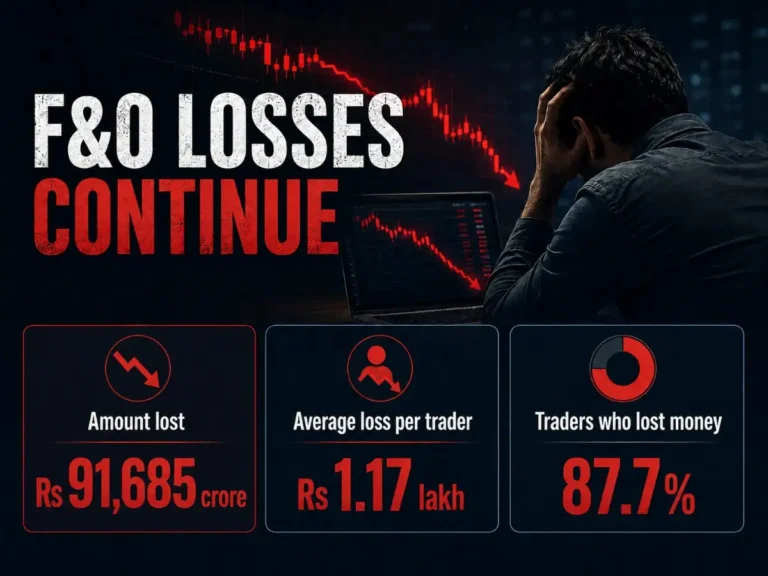
89% of individual retail traders who participated in India’s futures and options segment lost money in FY26. That figure comes directly from SEBI’s study on retail derivatives participation — and the F&O Traders Losses SEBI 2026 data is not an anomaly, a sample distortion, or a one-year blip. It continues a pattern that every prior SEBI study on this segment has confirmed, through FY22, FY24, and now FY26, each time with nearly identical loss percentages and a steadily growing absolute number of retail participants on the losing side. India’s F&O volumes hit record highs during FY25–FY26. The number of individual retail accounts trading derivatives expanded as zero-brokerage platforms reduced the entry cost to near zero. The participation boom and the loss data are not in contradiction — they are directly connected. This article covers what the SEBI study found, why the losses happen, what the aggregate rupee impact looks like, and what any retail investor considering derivatives needs to understand before placing a single trade.
What Is the SEBI F&O Traders Study 2026 and What Does It Show?
The SEBI report on futures and options traders is periodic regulatory research that SEBI (Securities and Exchange Board of India) publishes to track individual retail participant performance in India’s exchange-traded derivatives segment across NSE and BSE. This is not market commentary — it is a regulatory study built on anonymised trading account data submitted by registered brokers. SEBI analyses net profit and loss at the account level across the full financial year, separating individual retail participants from proprietary trading desks, foreign institutional investors (FIIs), and domestic institutional participants.
The SEBI F&O traders study 2026 covers the period April 2025 to March 2026 and is the most current regulatory dataset available on retail derivatives performance in India. The methodology distinguishes individual traders (retail accounts) from algorithmic and institutional participants, allowing the regulator to assess the outcome distribution for the segment that financial literacy campaigns most directly target.
The F&O Traders Losses SEBI 2026 report carries one finding that overshadows all others: the majority of retail losses are concentrated in options trading — both on the buying side and the selling side — rather than in futures. This matters because options are the instrument most heavily marketed by brokers, finfluencers, and trading education platforms as accessible to beginners.
89% F&O Traders Lost Money FY26 — What the Numbers Actually Mean
89% of individual F&O traders recorded a net loss in FY26 per the SEBI study. That leaves 11% in the profitable cohort — a figure that sounds encouraging until the composition of that 11% becomes clear. SEBI’s prior studies, which used identical methodology for FY22 and FY24, showed that the profitable minority is heavily concentrated among traders with multi-year experience, high-frequency trading infrastructure, or algorithmic systems. The purely discretionary retail participant — someone trading on chart patterns, tips, or option chain analysis — accounts for a small fraction of the profitable 11%.
The F&O Traders Losses SEBI 2026 data on aggregate rupee losses continues the upward trend that prior studies documented. SEBI’s FY24 study reported that individual traders collectively lost over ₹1.81 lakh crore across the three-year period FY22–FY24. The FY26 aggregate figure is expected to follow this trajectory given the participation growth in FY25–FY26; the exact FY26 total will be confirmed in the published report at SEBI’s official website.
The trend comparison removes any possibility that the FY26 result reflects market-specific circumstances. The loss percentage among retail individual traders has not improved materially across three consecutive SEBI studies despite mandatory risk disclosure requirements, broker-level warnings, and SEBI’s own investor education campaigns. More retail investors entered derivatives in FY25–FY26 than in any prior year — and the proportion losing money remained structurally unchanged.
F&O Trading vs Equity Delivery Investing — Side-by-Side for Retail Investors
The table below compares the two most common approaches Indian retail investors use to participate in equity markets, using measurable criteria rather than broad characterisations.
| Factor | F&O Trading | Equity Delivery Investing |
|---|---|---|
| Capital requirement | Lower (margin-based, but amplified exposure) | Full capital upfront — no leverage |
| Risk profile | Very high — losses can exceed initial margin | Moderate — maximum loss is invested capital |
| Skill level required | Advanced: Greeks, margin mechanics, expiry timing | Intermediate: fundamental and valuation analysis |
| Holding period | Intraday to weeks (contract expiry-bound) | Months to years |
| Tax treatment (India) | Business income — gains and losses under P&L from business | STCG at 20%, LTCG at 12.5% on delivery equity |
| SEBI-documented retail success rate | ~11% profitable (FY26 SEBI study) | Nifty 50: ~12–13% CAGR over 20-year average |
| Leverage impact | Amplifies both gains and losses proportionally | No leverage in delivery trades |
| Suitability for beginners | Low — requires deep technical understanding | Moderate — accessible with basic financial literacy |
| Monthly P&L monitoring | Required — positions expire, losses crystallise | Optional — unrealised losses can be held without forced exit |
The comparison above does not endorse equity delivery investing as a universally superior approach — both carry risk, and equity markets can produce extended periods of negative returns. The SEBI data makes the baseline outcome differential between the two approaches measurable rather than theoretical. For retail participants weighing how to allocate investable capital, that measurement is relevant.
Why F&O Traders Lose Money — Six Root Causes SEBI’s Data Points To
1. Leverage mismanagement. Futures and options positions use margin — a small capital outlay controls a large notional position. A 5% adverse move on the underlying index or stock can wipe 50–100% of the margin posted on a futures contract. Retail traders systematically underestimate this non-linear risk when entering positions, particularly during low-volatility market phases where margin requirements are temporarily compressed.
2. Options time decay (theta). An options buyer pays a premium that decays every calendar day toward contract expiry, independent of the underlying asset’s direction. SEBI’s studies show that most individual retail participation concentrates on the buying side of options — which is the structurally disadvantaged position in a low-to-moderate volatility environment. Theta works continuously and predictably against options buyers; the underlying must move fast and far enough to outpace the decay.
3. Trading without an edge. Professional proprietary desks and FIIs operating on NSE and BSE have execution speed, tick-level data feeds, and risk management systems that individual retail participants cannot replicate. Without a specific, tested, and quantified informational or analytical edge, options trading on these exchanges is a negative-sum game after accounting for brokerage and statutory charges.
4. Overtrading from zero-friction platforms. The near-elimination of brokerage costs on discount platforms reduced the psychological cost of each trade to essentially zero. SEBI’s prior studies noted that individual traders placing more than 100 orders per month consistently showed worse net outcomes than those trading infrequently. High-frequency discretionary trading amplifies errors; it does not reduce them.
5. Loss recovery behaviour. Individual traders who incur losses statistically increase their position sizes in subsequent sessions to recover capital quickly. This documented behavioural pattern — sometimes described as “revenge trading” — accelerates drawdowns because it combines impaired decision quality (driven by recent loss) with larger exposure per trade.
6. Expiry-day concentration. Weekly index options expiry concentrates maximum time decay into Thursday afternoon trading sessions. Retail traders who buy index options on expiry day face near-zero extrinsic value and maximum theta burn simultaneously — a structurally losing position for most participants regardless of the market’s intraday direction.
F&O Trading Risks for Beginners — What SEBI’s Framework Requires Brokers to Disclose
SEBI mandates that brokers display explicit risk disclosures — including the historical percentage of retail traders who lose money — before any retail investor activates F&O trading on their account. Post-2024 SEBI circulars strengthened these requirements, requiring the loss percentage to appear at the point of F&O activation rather than buried in terms and conditions. Brokers must now also display the average loss per trader from the most recently available SEBI study.
Margin calls represent one of the most misunderstood risks for retail derivatives traders. When a futures position moves against the trader and the account margin falls below the maintenance margin level, the broker issues a margin call requiring the immediate deposit of additional funds. If the trader cannot meet the margin call, the broker liquidates the position at the prevailing market price — crystalising the loss regardless of whether the trader believes the position would have recovered.
Options selling (writing) carries a separate and higher-order risk. Unlike options buying where the maximum loss equals the premium paid, an options seller faces theoretically unlimited losses if the underlying moves sharply against an uncovered position. A short call on an index that gaps up 10% overnight can generate losses many multiples of the initial premium received.
Tax treatment adds an asymmetry retail beginners routinely miss. F&O trading income and losses fall under “profits and gains from business or profession” under Indian income tax rules — not capital gains. This means F&O losses cannot offset salary income directly; they can only offset business income or carry forward for eight financial years.
SEBI also introduced tightened Know-Your-Client (KYC) and income verification standards for F&O account activation in 2024–2025. These changes, specifically designed to filter under-capitalised retail entrants from derivatives markets, require disclosure of annual income and net worth as part of the F&O activation process for new accounts.
How Much Money Do F&O Traders Lose in India — The Aggregate Picture
The aggregate picture of F&O trading losses in India confirms a structural transfer of capital from the retail individual segment to institutional and proprietary participants. SEBI’s FY24 study documented individual retail losses exceeding ₹1.81 lakh crore across three financial years. The F&O Traders Losses SEBI 2026 study is expected to show aggregate FY26 retail losses in a comparable range given the continued participation growth in FY25–FY26; exact figures will be available in the full SEBI report upon publication.
The distribution of those losses is not uniform. A disproportionate share comes from a small fraction of over-leveraged accounts — traders with high notional exposure relative to their capital base who face forced position liquidation during sharp intraday moves. The median retail individual trader loses a smaller absolute rupee amount but still finishes the financial year with a net negative outcome.
Transaction costs constitute a secondary but persistent drag on F&O outcomes. Securities Transaction Tax (STT) on options is levied at 0.1% of the premium on the buying side and at higher rates on exercise — structurally higher than STT on equity delivery transactions. Add GST at 18% on brokerage charges, exchange transaction charges, and SEBI regulatory fees, and even a zero-profit gross P&L position produces a net negative outcome for the year. The F&O Traders Losses SEBI 2026 data captures net P&L at the account level after brokerage but before all statutory charges — the actual household financial impact is higher than the study’s reported figures.
5 Tips for Retail Investors Before Starting F&O Trading
1. Read the SEBI risk disclosure fully before activating F&O. The F&O Traders Losses SEBI 2026 headline figure appears on every broker’s activation screen — but the full SEBI document provides the segment-level breakdown by trader tenure, order frequency, and capital size that gives far more actionable context than any single percentage. Brokers are required to link to it; reading it takes 20 minutes and provides better pre-entry calibration than most paid trading courses.
2. Paper-trade for a minimum of three months before committing real capital. Most discount brokers in India provide paper trading or virtual trading environments. Running simulated options trades for three full months — including tracking STT, time decay, and margin utilisation — produces a baseline performance record that is honest about actual skill level before permanent capital is at risk.
3. Cap F&O allocation at 5–10% of total investable capital. This is not a regulatory requirement; it is a risk management principle derived from the SEBI data’s distribution of losses. Accounts with the largest absolute losses in the SEBI study were concentrated among traders with high capital-at-risk relative to stated net worth. Position sizing, not trade selection, determines whether a losing streak causes manageable drawdown or permanent capital impairment.
4. Understand Delta, Theta, and Vega before purchasing a single contract. These three Greeks determine how an option’s price moves with the underlying’s price, time passing, and volatility changing. A retail investor buying a Bank Nifty call without understanding Theta is paying premium that decays regardless of whether the underlying rises — and regularly watches a nominally correct directional call expire worthless because time ran out before the move happened.
5. Track total transaction costs separately from gross P&L. Most retail traders monitor net position gain or loss without separately recording STT, GST, and exchange charges on each trade. Consistently tracking total friction costs reveals that many apparently breakeven or marginally profitable strategies are net-negative on a full-cost basis — which explains why disciplined discretionary traders often underperform a simple Nifty index fund over a full financial year.
Frequently Asked Questions — F&O Traders Losses SEBI 2026
Q1. What percentage of F&O traders lost money in FY26 according to SEBI? 89% of individual F&O traders recorded a net loss in FY26, per SEBI’s study. The remaining 11% who achieved profitability are disproportionately experienced multi-year traders or participants using algorithmic and systematic strategies. SEBI’s prior studies for FY22 and FY24 showed near-identical loss percentages, confirming this is a structural pattern rather than a single bad year.
Q2. What is the SEBI F&O traders study 2026 and where can retail investors access it? The study is a regulatory research paper published by SEBI (Securities and Exchange Board of India) that analyses anonymised F&O trading account data from registered brokers to measure individual retail participant outcomes across the full financial year. The full report and all prior editions are available on SEBI’s official website under the research and publications section at no cost.
Q3. Can a retail investor build consistent profits from F&O trading? The SEBI data shows 11% do — but consistent retail profitability in derivatives requires a tested systematic strategy, strict position sizing, and a genuine understanding of options pricing mechanics. Purely discretionary retail participants who trade on charts, tips, or option chain patterns without a documented edge represent the vast majority of the loss-making 89%. The separation between the two groups is strategy discipline and capital management, not luck or market timing.
Q4. Is F&O trading legal for retail investors in India? Fully legal and regulated. Futures and options on index and individual stocks trade on NSE and BSE under SEBI’s regulatory framework. SEBI does not restrict retail access to derivatives; it mandates income and net worth declarations, mandatory risk disclosures at account activation, and minimum margin requirements designed to filter structurally under-capitalised participants.
Q5. Should a beginner choose IPO investing or F&O trading to start building wealth? These are structurally different instruments with different capital requirements, skill demands, and risk profiles. IPO investing — applying for shares at the offer price and evaluating the company’s fundamentals for a long-term investment strategy — requires financial analysis skill but not real-time leverage management or derivatives pricing knowledge. F&O trading requires both, plus active margin monitoring and knowledge of expiry mechanics. India’s best IPOs for long term investment have historically compounded at 3x–15x over multi-year periods for disciplined fundamental investors. The F&O Traders Losses SEBI 2026 data and India’s IPO compounder track record represent two measurably different baseline outcome distributions — and a beginner choosing between them should let those numbers, not platform marketing, drive the decision.
Disclaimer
This article is published for educational and informational purposes only. The SEBI F&O traders study 2026 data cited is sourced from SEBI’s publicly available regulatory research. ipocontrol.in is not registered with SEBI as a research analyst, investment advisor, or portfolio manager. Nothing in this article constitutes investment advice, a recommendation to trade or avoid futures and options, or a solicitation to open or close any trading position. F&O trading involves significant risk, including the potential loss of more than the initial capital invested. Retail investors should read all mandatory risk disclosures provided by their broker before activating derivatives trading, and consult a SEBI-registered financial advisor before making any investment or trading decision.
SEBI Published the Numbers — What Retail Traders Do Next Is Entirely Their Own Choice
The F&O Traders Losses SEBI 2026 finding — 89% of individual retail traders losing money in FY26 — carries no ambiguity. It is not a projection, not a model output, and not a bearish market view from a commentator with a position. It is a regulatory measurement of what actually happened at the account level, across every broker, for every individual trader, in the full FY26 financial year.
India’s derivatives market serves legitimate economic purposes: institutional investors use futures to hedge portfolio risk, exporters use currency derivatives to manage foreign exchange exposure, and market-makers use options to provide the liquidity that retail traders execute against. The market is not broken. The problem is specifically the entry of under-prepared, under-capitalised, and under-informed retail participants into a high-skill, high-speed arena where professional participants have every structural advantage.
The F&O Traders Losses SEBI 2026 data does not prohibit participation. It prices the cost of entering without preparation — and that price, for 89% of FY26 individual participants, was a net loss. Financial literacy means reading that number, understanding what it represents, and deciding with that knowledge rather than without it.