
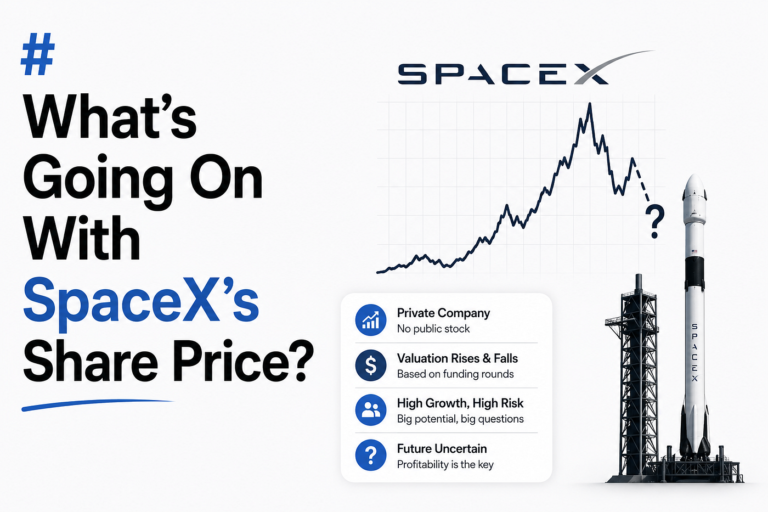
SpaceX stock price refers to the trading value of Space Exploration Technologies Corp.’s Class A shares, listed on Nasdaq under the ticker symbol SPCX since June 12, 2026. The IPO, which raised $86 billion at $135 per share, holds the record as the largest initial public offering in financial history, briefly pushing Elon Musk past the $1 trillion net worth threshold. Since that debut, the shares have swung dramatically: SPCX peaked at $211 within one week of listing and then corrected nearly 50% to around $105-$110 by late July 2026.
As of early October 2026, SPCX trades in the $115-$130 range, below its IPO price, as investors weigh a loss-making balance sheet against projections for Starlink, Starship, and the company’s artificial intelligence unit SpaceXAI. This guide covers the full picture: IPO mechanics, financial data, analyst price targets, and what Indian investors need to know about accessing the stock.
How SpaceX Stock Price Arrived on Nasdaq in June 2026
After years of rejecting a public listing, Elon Musk confirmed in December 2025 that SpaceX would go public. In February 2026, SpaceX acquired Musk’s AI company xAI at a combined valuation of $1 trillion for SpaceX and $125 billion for xAI, making the merged entity the most valuable private company at that point.
The roadshow ran from June 3 to June 11, 2026. Goldman Sachs and Morgan Stanley led a syndicate that also included JPMorgan Chase, Bank of America, and Citigroup. SpaceX set its IPO price at $135 per share before investor roadshows concluded, a move Reuters called “take-it-or-leave-it stock pricing.”
The offering covered 555,555,555 Class A shares with a greenshoe option of 83,333,333 additional shares, representing just 5% of total equity as free float. That restricted float, combined with Nasdaq-100 inclusion just 15 trading days after listing and early inclusion in CRSP, Dow Jones, and Russell indexes, produced extraordinary demand mechanics. The 70:30 institutional-to-retail allocation meant Indian retail investors who accessed SPCX on day one competed for a very small public pool.
Elon Musk holds 42% of shares and controls 82% of voting power through Class B shares, which carry 10 votes each versus one vote for Class A shares held by public investors.
SpaceX Stock Price Journey: $135 IPO, $211 Peak, and the Correction
SPCX opened trading on June 12, 2026 and closed its first session at $161, a 19% gain from the IPO price of $135. The first-week run continued, with SPCX reaching an intraday high of $211 before sellers stepped in.
That $211 peak placed SpaceX’s market capitalisation above $2.7 trillion. Analysts at short-seller firms flagged the stock as significantly overvalued at that level, noting it traded at approximately 67 times trailing sales at IPO price, roughly three times Nvidia’s price-to-sales multiple at the same time. The free float mechanism, which limited genuine price discovery to a tiny fraction of total shares, contributed to the spike.
By mid-July 2026, roughly one month after the IPO and days after underwriting banks published 12-18 month price targets, the SpaceX stock price fell below its $135 IPO price and continued sliding to $123-$125. By late July, shares had declined approximately 50% from the $211 peak. The company’s net loss of $4.94 billion in FY2025, combined with the absence of S&P 500 eligibility (which requires four consecutive profitable quarters under US GAAP), weighed on sentiment.
The 366-day lock-up period preventing Musk and other insiders from selling does not expire until June 12, 2027. When that lock-up expires, the effective float expands substantially, which represents a structural overhang investors continue to price in.
Segment Financials: What SpaceX Actually Earned in FY2025

SpaceX reported total revenue of $18.7 billion for FY2025 across three operating segments. Understanding which segment makes money is essential for evaluating any SpaceX stock price target.
Starlink, the satellite internet connectivity division, generated $11.4 billion in FY2025 revenue and posted a profit of $4.4 billion, making it the only profitable segment. Subscribers stood at approximately 10 million as of the IPO filing, with projections for growth to nearly 17 million by end of 2026. The first quarter of 2026 showed Starlink revenue of $3.26 billion. Starlink operates a constellation of over 7,000 low-Earth-orbit satellites and serves residential, commercial, maritime, and aviation customers across more than 100 countries. The service competes with traditional fixed broadband, Viasat, and OneWeb in the satellite connectivity segment.
The Space segment, which covers Falcon 9, Falcon Heavy, Starship, and Dragon, generated $4.1 billion in FY2025 revenue but reported a loss of $657 million. Falcon 9 averaged approximately three launches per week as of May 2026. Starship, which forms the basis of NASA’s Artemis lunar lander contract, continues test flights.
SpaceXAI, the artificial intelligence segment housing the xAI acquisition, generated $3.2 billion in FY2025 revenue but posted a loss of $3.2 billion in the same period. The segment operates Grok large language models, the social network X, and large-scale GPU data centers under the Colossus brand. Agreements with Anthropic ($1.25 billion per month) and Google ($920 million per month) provide significant contracted revenue, though both contracts carry 90-day termination clauses. SpaceX’s overall net loss reached $4.94 billion in FY2025, with total assets of $92.1 billion and total equity of just $2.6 billion.
SpaceX Stock Price vs 2026 Analyst Price Targets
The table below captures the range of analyst price targets issued by underwriting banks within 30 days of the IPO, along with independent analyst assessments of fair value.
| Analyst / Firm | 12-18 Month Price Target | Implied Gain from $135 IPO | Basis |
|---|---|---|---|
| Raymond James | $800 | +493% | AI TAM optimism |
| Morgan Stanley | $300 | +122% | Starlink + xAI growth |
| Underwriter Consensus Median | $225 | +67% | Blended segment model |
| Stifel | $190 | +41% | Conservative segment view |
| Aswath Damodaran (independent) | $1.3 trillion EV (~$100/share) | Below IPO | Segment-by-segment DCF |
| Morningstar | $780 billion EV (~$60/share) | Significantly Below IPO | GAAP profitability screen |
Source: Bank research notes and public analyst commentary, July 2026. Per-share estimates for Damodaran and Morningstar are approximate, derived from enterprise value divided by total diluted shares.
Professor Jay Ritter of the University of Florida described the uniformity of underwriter targets as “mechanical copycat” behavior, noting banks anchor to each other rather than independently modelling a company with no profitable GAAP history. Mornigstar placed fair value at $780 billion, roughly 44% below the IPO price in enterprise value terms.
SPCX in the secondary market will face a significant test when the 180-day staggered lock-up for pre-IPO investors begins to expire in December 2026, ahead of the full 366-day insider lock-up in June 2027.
Why SPCX Still Trades Below Its IPO Price
Three structural factors weigh on SpaceX stock price as of October 2026. First, the company has not achieved GAAP net profitability, which keeps it out of the S&P 500 and limits mandatory index-driven buying from the largest passive funds globally. Second, SpaceX’s free float remains near 5%, creating thin trading conditions that amplify both upside moves and corrections. Third, the lock-up overhang represents billions of dollars in insider shares that cannot yet enter the market.
The valuation case for SPCX rests almost entirely on the AI segment’s ability to grow from $3.2 billion in FY2025 revenue into a multi-hundred-billion-dollar business. Goldman Sachs projected $474 billion in total SpaceX revenue by 2030 and Morgan Stanley projected $330 billion. Independent analysts noted these projections require xAI to capture a meaningful share of an AI total addressable market SpaceX pegs at $26.5 trillion, a figure critics describe as implausible given that xAI competes with Google DeepMind, OpenAI, and Anthropic for enterprise AI workloads.
Starlink’s profitability provides the fundamental floor. At $4.4 billion in FY2025 segment profit and growing subscribers, Starlink alone at peer satellite internet multiples could justify a significant portion of the IPO valuation. The Space business, boosted by government contracts from NASA, the US Space Force, and the National Reconnaissance Office, provides stable revenue even if margins remain thin.
How Indian Investors Can Track and Access SpaceX Stock
Indian investors cannot purchase SPCX directly through the NSE or BSE, as the stock trades exclusively on Nasdaq in the United States. However, access is available through two primary routes.
The Reserve Bank of India’s Liberalised Remittance Scheme (LRS) permits Indian residents to remit up to $250,000 per financial year overseas. Through LRS, investors can open accounts with US-registered brokers and purchase SPCX shares directly. Any remittance under LRS for investment purposes requires compliance with FEMA (Foreign Exchange Management Act) guidelines and reporting requirements.
Alternatively, Indian investors can gain indirect exposure through domestic mutual funds that allocate to US technology equities or global innovation funds. SEBI-registered fund houses including Mirae Asset, Motilal Oswal, and Franklin Templeton offer feeder funds and fund-of-funds structures that hold positions in Nasdaq-listed technology stocks.
Investors tracking global IPO events alongside Indian IPO GMP data can visit the IPO GMP today tracker on ipocontrol.in for real-time comparisons with Indian mainboard IPOs listing on NSE and BSE.
The Bigger Picture on SpaceX Stock Price in 2026
SpaceX stock price represents a bet on whether three distinct businesses, satellite internet, reusable space access, and orbital AI infrastructure, can collectively justify a $1.77 trillion valuation that currently rests on a loss-making consolidated income statement.
Starlink provides the only profit today. Space launches provide the cash flow foundation. SpaceXAI generates losses that exceed the combined operating profit of the other two segments. For SpaceX stock price to reach even the $225 consensus target, xAI must demonstrate sustained revenue growth and a path to margin, while Starlink must maintain its subscriber trajectory to 17 million by end of 2026.
The SpaceX stock price dip below its $135 IPO level in mid-July 2026 marked the first real test of retail investor conviction. Whether the stock recovers to analyst targets or continues to reprice toward independent fair value estimates depends on quarterly results and Starlink subscriber data that will emerge through Q3 and Q4 2026 earnings releases. Investors should track live SPCX quotes directly on Nasdaq’s official stock screener and review earnings releases at the SEC’s EDGAR system before making any investment decision.
Frequently Asked Questions on SPCX
What exchange lists SPCX, and when did SpaceX go public? SpaceX listed on Nasdaq under the ticker SPCX on June 12, 2026. It raised $86 billion in the largest IPO in history, priced at $135 per share, led by Goldman Sachs and Morgan Stanley.
How does SpaceX generate revenue if it reports a net loss? SpaceX operates three segments. Starlink (satellite internet) was profitable at $4.4 billion net income in FY2025. The Space segment (Falcon 9, Falcon Heavy, Starship) reported a modest loss of $657 million. SpaceXAI reported a $3.2 billion loss, which dominated the $4.94 billion consolidated net loss for FY2025.
Can Indian investors buy SPCX through NSE or BSE? No. SPCX trades only on Nasdaq. Indian investors access it via the LRS (up to $250,000 per year through FEMA-compliant overseas remittance) or through SEBI-registered mutual funds that hold US technology stocks.
What is the analyst consensus SpaceX stock price target for 2026? Of 17 underwriting banks that issued targets, the median 12-18 month price forecast for SPCX stands at $225, with a range from $190 (Stifel) to $800 (Raymond James). Independent analysts Damodaran and Morningstar placed fair value significantly below the IPO price.
Why did SpaceX stock price fall below $135 after such a strong debut? The IPO debut benefited from manufactured scarcity: only 5% of shares were in public float, combined with early index inclusion that forced index funds to buy. Once index-driven buying normalised and analyst research pointed to GAAP losses and valuation concerns, selling pressure pushed SPCX below its $135 offer price by mid-July 2026.
Disclaimer: This article is for educational and informational purposes only. It does not constitute investment advice. ipocontrol.in is not registered with SEBI as an investment adviser. Investors should consult a SEBI-registered financial adviser before making investment decisions.