
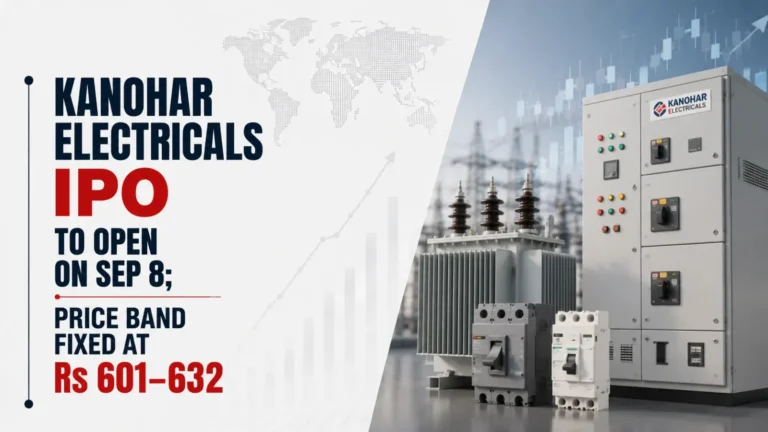
India plans to add over 500 GW of renewable energy by 2030 and electrify 100% of its railway network — but how many companies in India are actually certified to build the transformers that make that infrastructure work? The Kanohar Electricals IPO, opening September 8, 2026 at ₹601–₹632 per share, is one of five certified transformer manufacturers in India carrying the short circuit test qualification for 500 MVA 400 kV transformers — a ₹1,055 crore mainboard issue listing on BSE and NSE.
The Kanohar Electricals IPO 2026 presents a specific financial story: a 54-year-old Meerut-based manufacturer that posted 267% PAT growth in FY25, followed by another near-doubling of PAT in FY26 (₹65 crore to ₹130 crore), entering the public markets at ₹632 per share with fresh issue proceeds partly backing genuine manufacturing capex at its Gangol facility. The structural concern to balance against that growth story is the 71.6% OFS component, where K Sons Family Trust — the promoter entity — exits ₹755 crore of their holding at the IPO price, meaning most of the capital raised goes to the promoter, not the company.
What Is Kanohar Electricals Limited — Transformers, EPC, and the Infrastructure Demand Behind the Issue
Kanohar Electricals Limited was founded in 1972 and is headquartered in Meerut, Uttar Pradesh, operating two manufacturing facilities at Rithani, Meerut with a combined installed capacity of 19,200 MVA. The company operates across two business segments: Transformer Manufacturing and an EPC Business.
The Transformer Manufacturing segment produces power transformers, traction transformers, Scott transformers, shunt reactors, and distribution transformers for power utilities, railway networks, and renewable energy developers. The EPC Business provides substation and transmission line EPC solutions for infrastructure projects across India.
Primary end-markets span four verticals: power transmission (PGCIL and state utilities), railways (Indian Railways traction and Scott transformer procurement), renewable energy (step-up transformers for wind and solar farms), and power distribution. Two hard-to-replicate certifications define Kanohar’s competitive moat:
- RDSO certified: One of four manufacturers in India certified to produce 100 MVA 132 kV Scott transformers — a procurement prerequisite for Indian Railways traction network contracts.
- Short circuit test certification for 500 MVA 400 kV transformers: Kanohar Electricals Limited is one of just five companies in India holding this qualification, mandatory for PGCIL’s ultra-high-voltage transmission network orders.
These certifications are procurement filters, not marketing claims. Government and PSU buyers cannot place contracts with non-certified vendors, which structurally limits the competitive pool on the highest-value transformer orders in the country. The broader power infrastructure expansion — part of the ongoing buildout covered in private investment in India sectors — makes transformer demand non-discretionary for grid expansion through at least 2030.
Kanohar Electricals IPO Date, Price Band, and Subscription Details
The Kanohar Electricals IPO opens for subscription on September 8, 2026 and closes September 10, 2026 at a price band of ₹601–₹632 per share (face value ₹2). Lot size is 23 shares, placing the minimum retail application at ₹14,536 at the upper band.
This subscription window runs simultaneously with Glass Wall Systems and Prasol Chemicals (also September 8–10) — each ASBA or UPI application is independent and uses a separate bank block; applying to multiple issues does not affect allotment chances in any of them.
Application Details (at ₹632 upper band):
| Category | Lots | Shares | Application Amount |
|---|---|---|---|
| Retail – Minimum | 1 lot | 23 shares | ₹14,536 |
| Retail – Maximum | 13 lots | 299 shares | ₹1,89,068 |
Investor Category Reservation:
| Category | Allocation |
|---|---|
| QIB | 50% |
| NII / HNI | 15% |
| Retail Individual Investor (RII) | 35% |
QIBs receive the largest slice at 50%, making institutional subscription the primary metric to watch on Days 1 and 2. Nuvama Wealth Management and IIFL Capital Services are the BRLMs; MUFG Intime India Pvt. Ltd. is the registrar. Allotment finalises September 11, 2026; listing on BSE and NSE follows September 16, 2026.
IPO Structure — Fresh Issue Capex Quality and the K Sons Family Trust OFS
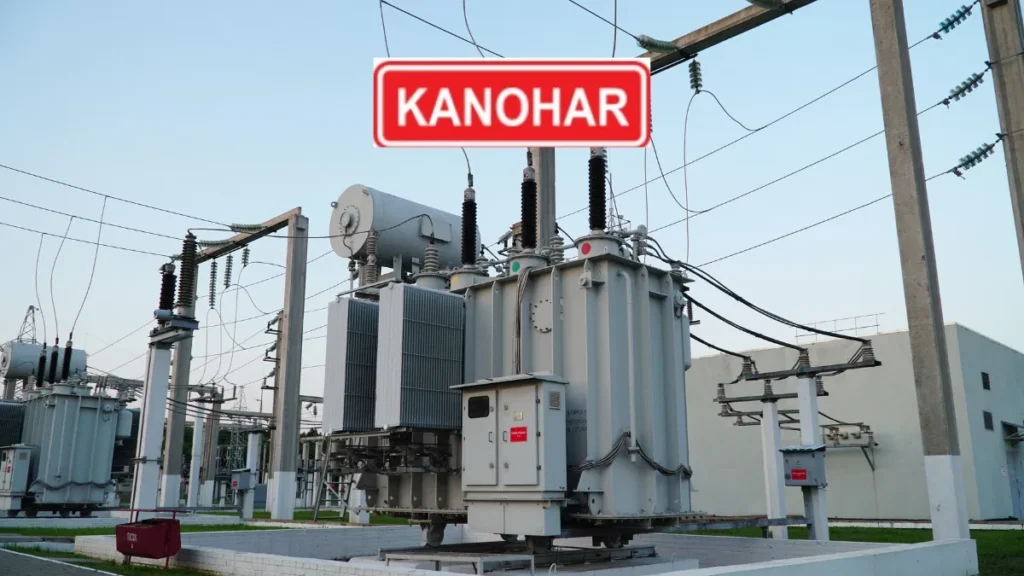
The total issue is ₹1,055.74 crore: a ₹300 crore fresh issue (28.4%) and an OFS of ₹755.74 crore (71.6%). In the Kanohar Electricals IPO, the OFS is conducted entirely by K Sons Family Trust — the promoter-linked trust — which means retail investors at ₹632 per share are primarily buying from the promoter rather than funding new company capacity.
Objects of Fresh Issue (₹300 crore):
| Purpose | Amount (₹ Crore) |
|---|---|
| Incremental working capital | ₹130 |
| Capex — Gangol facility (new machinery/equipment, backward integration expansion and automation, civil works, solar power plant, EVs for internal logistics) | ₹66.74 |
| General corporate purposes | ~₹103.26 |
The fresh issue quality requires honest assessment. Only ₹66.74 crore — 22% of the fresh issue — goes to genuine production-capacity capex at the Gangol facility; ₹130 crore (43%) services working capital requirements necessary for long-cycle transformer projects (12–24 months), and ~₹103 crore is allocated to general corporate purposes with no specific committed use. For comparison, the Glass Wall Systems IPO in the same September 2026 batch directed 83% of its fresh issue toward a single backward-integration capex project. Post-IPO promoter stake percentage should be verified from the final RHP — with K Sons Family Trust selling ₹755 crore, the remaining promoter holding is a governance checkpoint that matters for listing-day and post-listing dynamics.
Kanohar Electricals IPO Financials — Three Years of Compounding Growth
The financial record the Kanohar Electricals IPO presents to the market spans three verified years of accelerating growth — a trajectory rare in manufacturing-sector IPOs. In FY24, the company delivered revenue of ₹276.6 crore with an EBITDA of ₹31 crore and a PAT of ₹17.75 crore — a 6.4% PAT margin reflecting a manufacturing base operating well below peak utilisation.
Financial Performance (FY24–FY26):
| Year | Revenue (₹ Cr) | EBITDA (₹ Cr) | PAT (₹ Cr) | PAT Margin | YoY PAT Growth |
|---|---|---|---|---|---|
| FY24 | ₹276.6 | ₹31 | ₹17.75 | 6.4% | — |
| FY25 | ₹450.6 | ₹93.3 | ₹65.11 | 14.4% | +267% |
| FY26 | ₹662.86 | — | ₹129.73 | 19.6% | +99% |
H1 FY26 actuals (Apr–Sep 2025): Revenue ₹165.5 Cr | PAT ₹30.67 Cr
FY25’s performance is the most structurally revealing year. Revenue grew 62.9% to ₹450.6 crore — but EBITDA tripled from ₹31 crore to ₹93.3 crore, and PAT surged 267% from ₹17.75 crore to ₹65.11 crore. This is classic operating leverage: a fixed-cost manufacturing base where incremental revenue falls disproportionately to the bottom line once the utilisation threshold is crossed. FY26 then extended both trajectories — revenue grew 47.1% to ₹662.86 crore while PAT nearly doubled again to ₹129.73 crore, pushing the PAT margin to 19.6%.
A 19.6% PAT margin is unusually high for transformer manufacturing, where the sector median runs 8–12%; the most credible explanation is a product mix shift toward higher-margin power and traction transformers and away from lower-margin distribution products. Retail investors should verify this from the RHP product segment breakdown. Total borrowings and the D/E ratio were not confirmed in available sources at the time of writing — verify from the FY26 RHP balance sheet before applying.
Kanohar Electricals vs Listed Electrical Equipment Peers — How Does the Valuation Stand?
Measured against listed peers in the electrical equipment sector, the Kanohar Electricals IPO at ₹632 per share sits at a valuation that requires context from the peer group. Using FY26 PAT of ₹129.73 crore, an estimated P/E of ~30–40x positions the company below the multinational premium brands and above BHEL.
Peer Comparison Table — Transformer & Electrical Equipment Companies:
| Company | Business | Approx. P/E (FY26) | Notes |
|---|---|---|---|
| Kanohar Electricals (IPO) | Power/traction/Scott transformers + EPC | ~30–40x (est.) | Listing Sep 16, 2026 |
| Voltamp Transformers | Power/distribution transformers | ~25–35x | Domestic-focused, mid-cap |
| CG Power & Industrial Solutions | Diversified electrical + power | ~60–80x | Premium for scale + brand |
| Hitachi Energy India | T&D systems, high-voltage | ~100–130x | Global brand premium |
| ABB India | Automation + T&D | ~80–100x | Global brand premium |
| BHEL | Heavy electrical (incl. transformers) | ~35–50x | PSU; diversified |
P/E estimates are indicative ranges at time of writing; verify current live multiples from nseindia.com or bseindia.com before publishing.
At ~30–40x, Kanohar sits at a meaningful discount to ABB India (~80–100x), Hitachi Energy India (~100–130x), and CG Power (~60–80x) — all of which trade at premiums partly explained by scale, global brand recognition, or diversified product portfolios. The closest comparable is Voltamp Transformers at ~25–35x. The key argument for a Kanohar premium over Voltamp is the RDSO and 500 MVA short-circuit certifications, which create a structural, policy-backed order-flow advantage that a simple P/E comparison does not capture. If PAT margins sustain at 19.6%, a re-rating toward 40–60x is not implausible over 12–24 months; if margins moderate toward sector norms post-2027, the current entry valuation warrants closer scrutiny.
Kanohar Electricals IPO GMP Today — Status, Platforms, and What to Watch
The Kanohar Electricals IPO GMP had not commenced as of September 3–7, 2026 — the subscription window had not yet opened, and grey market trading for mainboard issues typically begins 24–48 hours after subscription starts. Once the issue opens September 8, GMP data will appear on Chittorgarh (chittorgarh.com), IPO Watch (ipowatch.in), a2zipo (a2zipo.com), and IPO Index (ipoindex.in).
For a transformer company with three years of compounding PAT growth and direct exposure to India’s power infrastructure upcycle, the following GMP ranges provide context:
- GMP ₹40–₹80 on ₹632 (6–13% premium): Indicates informal market confidence in the fundamentals and listing valuation.
- GMP below ₹20: Caution signal — suggests market concern on valuation given the OFS quantum.
- GMP above ₹100 (>15%): Potentially overheated; watch for post-listing correction pressure.
SEBI does not regulate grey market activity, and the GMP does not predict the actual listing price on September 16. Live IPO subscription data updates in real time at nseindia.com and bseindia.com from September 8 — QIB category coverage by Day 2 (September 9) is the most reliable forward signal for a ₹1,055 crore mainboard issue.
Five Risks to Evaluate Before September 10
OFS at 71.6% means the promoter exit dominates the issue. Of ₹1,055 crore raised, ₹755.74 crore flows to K Sons Family Trust rather than the company; retail investors at ₹632 are primarily purchasing from the promoter, not funding the electrical industry manufacturer’s growth.
Government and PSU client concentration creates procurement risk. PGCIL, state DISCOMs, and Indian Railways dominate Kanohar Electricals Limited’s order pipeline — procurement delays, budget deferrals, or policy shifts by these clients can compress order inflows and stagger revenue recognition across quarters.
Working capital is the largest single use of fresh proceeds. The ₹130 crore working capital allocation is necessary for long-cycle transformer projects (12–24 months) but does not add production capacity — retail investors expecting capex-driven growth should note that genuine production capex (₹66.74 crore) is only 22% of the fresh issue.
High PAT margins may reflect a cyclical peak rather than a structural step-up. The transformer sector runs in demand supercycles tied to government infrastructure spending; if post-2027 order flows moderate, the 19.6% FY26 PAT margin may revert toward the 8–12% sector median over two to three years.
Three-year financial history covers only an infrastructure upcycle. The available record (FY24–FY26) coincides entirely with a high-growth environment — Kanohar’s behaviour during a demand slowdown or competitive pricing pressure has not been tested in the available data.
Practical Tips for Retail Investors Applying to This September 2026 Issue
Apply at the cut-off price (₹632) to protect allotment eligibility. In book-building issues, bids below the final issue price are automatically rejected — cut-off bids remain valid across the full ₹601–₹632 range regardless of where the book closes within the band.
Monitor QIB subscription at 5 PM on September 8 and midday on September 9. For a ₹1,055 crore mainboard issue, QIB 1x coverage by Day 2 is the most reliable signal of institutional conviction; tepid QIB numbers on a large-ticket issue have historically been a pre-listing caution signal.
Track GMP on Chittorgarh and IPO Watch from September 8 afternoon. A GMP above ₹40 on a ₹632 price would indicate informal market confidence in the issue’s IPO subscription momentum; flat or negative GMP on this financial profile would warrant reassessment before the September 10 close.
Read the promoter’s post-IPO stake in the final RHP before applying. K Sons Family Trust sells ₹755.74 crore in OFS — verify the promoter’s remaining holding percentage in the RHP, as post-listing promoter stake below 50% would raise additional governance questions that institutional investors will price in.
Check allotment at the MUFG Intime India registrar portal on September 11. Use PAN or application number to check the Kanohar Electricals IPO allotment date result at the MUFG Intime platform; also available via broker platforms including Zerodha, Groww, AngelOne, and HDFC Sky. Demat credit and ASBA fund unblocking follow before the September 16 BSE and NSE listing.
Frequently Asked Questions
What is the Kanohar Electricals IPO GMP today?
The Kanohar Electricals IPO GMP had not commenced as of September 3–7, 2026 — the grey market requires an active subscription window before trading begins. GMP data will appear on Chittorgarh, IPO Watch, a2zipo, and IPO Index from September 8 onward. SEBI does not regulate grey market activity; the GMP does not guarantee the actual listing price on September 16. Live subscription data from nseindia.com and bseindia.com serves as the most reliable real-time market signal from September 8.
What is the IPO date, price band, and lot size?
Subscription opens September 8, 2026 and closes September 10, 2026. The price band is ₹601–₹632 per share (face value ₹2); lot size is 23 shares, with a minimum retail application of ₹14,536 at the upper band. Allotment finalises September 11, 2026, and the issue lists on BSE and NSE on September 16, 2026.
What does Kanohar Electricals Limited actually manufacture?
Kanohar Electricals Limited, founded 1972 and based in Meerut, manufactures power transformers, traction transformers, Scott transformers, shunt reactors, and distribution transformers across two facilities at Rithani, Meerut (combined capacity: 19,200 MVA). The EPC Business provides substation and transmission line solutions. Primary clients include PGCIL, state DISCOMs, Indian Railways, and renewable energy developers.
How can investors check allotment status after September 11?
Allotment finalises September 11, 2026. Check status at the MUFG Intime India Pvt. Ltd. registrar portal using PAN or IPO application number. Allotment results also appear on broker platforms — Zerodha, Groww, AngelOne, and HDFC Sky all display finalised allotment data within hours. Demat credit and refunds follow before the September 16 BSE and NSE listing.
Why did the company’s PAT grow 267% in FY25?
Revenue scaled from ₹276.6 crore (FY24) to ₹450.6 crore (+62.9%) as power infrastructure orders accelerated; EBITDA nearly tripled from ₹31 crore to ₹93.3 crore as operating leverage took effect on the fixed-cost manufacturing base. PAT surged from ₹17.75 crore to ₹65.11 crore as revenue crossed the utilisation break-even threshold, and a concurrent shift toward higher-margin power and traction transformers amplified the bottom-line impact. The product mix explanation should be verified from the RHP segment breakdown before applying.
The Kanohar Electricals IPO Makes a Compelling Case in India’s Highest Power Infrastructure Spending Cycle in Two Decades
The three-part thesis is clear: a 54-year-old, RDSO-certified transformer manufacturer operating in a pool of fewer than five certified competitors, three years of compounding growth from ₹17.75 crore PAT to ₹129.73 crore, and a structural demand tailwind from India’s 500 GW renewables target, railway electrification, and grid expansion — all requiring transformer capacity that only a handful of certified manufacturers can supply. The structural caution — 71.6% OFS by a promoter trust — is equally real and should not be read as secondary; the majority of the ₹1,055 crore raised exits to the promoter rather than building the company.
Disclaimer: This article is for informational and educational purposes only and does not constitute investment advice or a recommendation to buy or sell any securities. IPO investments are subject to market risks. Read all related documents carefully before investing. This site is not registered with SEBI as an investment advisor. Consult a SEBI-registered financial advisor before making investment decisions.
For investors willing to weigh those two sides, the signals to track are GMP from September 8 afternoon, QIB coverage by September 9 midday, and allotment results on September 11. Live subscription data at nseindia.com runs from September 8 — and in a September 2026 mainboard IPO calendar that includes Glass Wall Systems and Prasol Chemicals in the same window, institutional conviction on this transformer manufacturer will be the earliest objective signal of how the market prices India’s highest-certified electrical equipment manufacturer against the promoter exit overhang.
Disclaimer: This article is for informational and educational purposes only and does not constitute investment advice or a recommendation to buy or sell any securities. IPO investments are subject to market risks. This site is not registered with SEBI as an investment advisor.