

The Tata Power Share Price closed at ₹362 on September 28, 2026, placing the stock within ₹20 of its 52-week low of ₹342. That proximity to a year-long trough, despite the company reporting a record net profit of ₹5,118 crores in FY2026, creates an important divergence every investor should understand before forming a view.
Tata Power Company Limited (NSE: TATAPOWER) carries a market capitalisation of ₹1,15,639 crores and trades at a P/E of 29.5x, a premium to peers like Adani Power (26.5x) and Torrent Power (26.8x). Whether that premium is justified or is the very reason the stock has shed 7% over the past year is the core question this article addresses.
Where Tata Power Share Price Stands Today: Key Market Metrics
The stock has moved in a wide band over the past twelve months. The 52-week high of ₹465 (hit in late 2025) represents a potential downside of roughly 22% from that peak. The 52-week low of ₹342 sits just 5.5% below the current price.
| Metric | Value |
|---|---|
| Current Share Price (NSE/BSE) | ₹362 (Sep 28, 2026) |
| 52-Week High | ₹465 |
| 52-Week Low | ₹342 |
| Market Capitalisation | ₹1,15,639 Crores |
| P/E Ratio (TTM) | 29.5x |
| Book Value Per Share | ₹124 |
| Price to Book (P/B) | 2.93x |
| Dividend Yield | 0.69% |
| ROCE | 10.5% |
| ROE | 10.2% |
| Face Value | ₹1 |
On NSE, the stock trades under the ticker TATAPOWER. BSE investors track the same company under the same name. Both exchanges reflect identical live share price feeds, with any minor spread closing within milliseconds on a normal trading day. The current trading volume for TATAPOWER is among the highest in the power sector, reflecting its standing as a large-cap, index-member stock in the Nifty Next 50.
FY2026 Financials: Revenue Moderation, Record Profit and Margin Expansion
The financial year ended March 2026 produced a mixed picture. Revenue declined marginally from ₹65,478 crores in FY2025 to ₹62,429 crores in FY2026, a 4.7% contraction. Yet net profit grew to ₹5,118 crores from ₹4,775 crores in FY2025.
| Financial Year | Revenue (₹ Cr) | EBITDA (₹ Cr) | OPM (%) | Net Profit (₹ Cr) | EPS (₹) |
|---|---|---|---|---|---|
| FY2023 | 55,109 | 7,728 | 14% | 3,810 | 10.44 |
| FY2024 | 61,449 | 10,735 | 17% | 4,280 | 11.57 |
| FY2025 | 65,478 | 12,450 | 19% | 4,775 | 12.43 |
| FY2026 | 62,429 | 13,271 | 21% | 5,118 | 11.73 |
The EBITDA margin expanded from 19% in FY2025 to 21% in FY2026 despite the revenue dip, a strong signal of improving operational efficiency. The EBITDA for FY2026 stood at ₹13,271 crores, an all-time high for the company.
The revenue decline reflects project timing in the renewables and EPC segments, where recognising income depends on construction milestones. Tata Power’s distributed solar business, EV charging network, and power distribution businesses added incremental recurring revenue, partially offsetting lumpy project revenue declines.
The most recent quarterly earnings (June 2026 quarter) showed sales of ₹19,051 crores, up 5.63% year-on-year. Net profit came in at ₹1,401 crores, a 10.95% rise over the same quarter last year. The quarterly EPS of ₹3.68 annualises to approximately ₹14.72, suggesting the consensus FY2027 earnings estimate runs ahead of FY2026’s ₹11.73 EPS.
Tata Power Share Price Peer Comparison: Premium Valuation at a Glance
The Tata Power Share Price carries a valuation premium over all major power sector peers except NTPC-adjacent renewables plays. Here is how Tata Power stacks up against key listed comparables available on NSE’s equity market and BSE.
| Company | CMP (₹) | P/E (x) | Market Cap (₹ Cr) | Dividend Yield (%) | ROCE (%) |
|---|---|---|---|---|---|
| Tata Power Co. | 362 | 29.5x | 1,15,639 | 0.69% | 10.5% |
| Adani Power | 196 | 26.5x | 3,78,250 | 0.00% | 17.2% |
| Torrent Power | 1,237 | 26.8x | 62,343 | 1.62% | 13.7% |
| CESC | 136 | 11.6x | 18,052 | 4.41% | 10.9% |
Data: Screener.in | As of September 28, 2026
The contrast in ROCE is telling. Adani Power delivers 17.2% ROCE and Torrent Power 13.7%, both on lower P/E multiples than Tata Power. CESC trades at a steep discount (11.6x P/E) but offers a 4.41% dividend yield. Tata Power’s 10.5% ROCE fails to justify the 29.5x multiple on fundamentals alone; investors who own the stock are pricing in future earnings acceleration from the renewable energy transition, not current capital returns.
How the Debt Load Shapes the Tata Power Share Price Outlook
Tata Power’s balance sheet carries borrowings of ₹76,141 crores as of FY2026, up sharply from ₹52,923 crores in FY2023. Interest expense for FY2026 reached ₹5,257 crores, against an operating profit of ₹13,271 crores, an interest coverage ratio of approximately 2.5x.
That level of leverage is standard for a capital-intensive power utility scaling renewable capacity, but it creates earnings sensitivity to interest rate movements. Tata Power has been investing aggressively in solar generation, pumped hydro, and EV charging infrastructure, all of which require multi-year capital deployment before generating cash flows. The CWIP (Capital Work-in-Progress) on the balance sheet stood at ₹14,595 crores in FY2026, confirming substantial ongoing capex.
This debt trajectory is the primary headwind that keeps the Tata Power Share Price range-bound despite improving profitability. A rating agency or bond market event that affects borrowing costs would directly impact the company’s earnings trajectory, and by extension, the stock price.
The dividend payout remains conservative at 0.69% yield at current market price, consistent with the company’s strategy of reinvesting cash flows into capex rather than distributing them.
Tata Power Share Price Target 2026: Earnings-Based Valuation Framework
Analysts who cover Tata Power on NSE and BSE anchor their share price targets to earnings and EV/EBITDA multiples for power utilities. Based on FY2026 EPS of ₹11.73 and the most recent quarter’s annualised run rate of approximately ₹14-15 EPS, the implied fair value range at different P/E scenarios runs as follows.
Investors tracking the latest broker and analyst targets can access detailed research via Moneycontrol’s brokerage target section and Economic Times Markets, both of which aggregate price targets from Indian equity research desks.
At the current sector P/E of approximately 27x and applying a 10-15% premium for Tata Power’s renewable energy positioning, the implied valuation at FY2027 earnings of ₹14-15 would suggest a target range of ₹378 to ₹450. The lower end of that range (₹378) represents less than 5% upside from current levels, while the upper end (₹450) aligns closely with the 52-week high of ₹465.
The bear case centres on three risks: debt rising faster than EBITDA growth, revenue slippage in thermal power during policy transitions, and project execution delays in the renewables pipeline pushing earnings beyond FY2028.
The bull case depends on Tata Power’s renewable capacity additions delivering revenue ahead of schedule, sustained margin expansion above 20% EBITDA margin, and any re-rating of the peer P/E band higher as India’s clean energy narrative strengthens. Investors comparing this sector with recent infrastructure IPOs can also check the Vishal Nirmiti IPO review, a railway infrastructure company that listed in October 2026, a useful lens on how the market prices infrastructure growth stories at the IPO stage versus the listed stage.
Tata Power’s Business Segments and Why They Drive the Stock Narrative
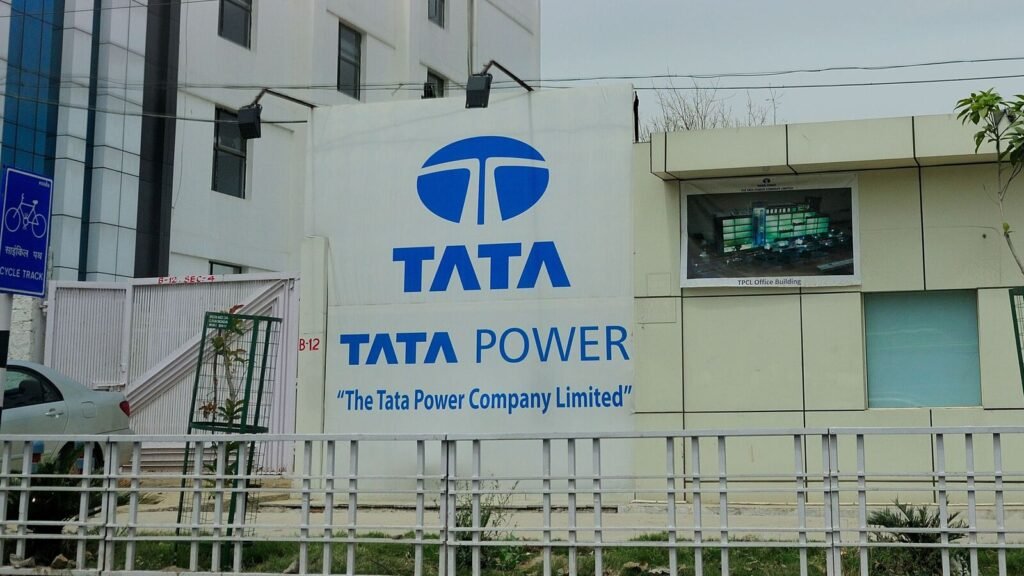
Tata Power Company operates across five major business lines. The regulated power generation and distribution segment (covering Mumbai’s electricity supply) generates predictable, tariff-linked revenue. The renewable energy segment is the growth driver, with the company targeting significant solar and wind capacity additions.
Beyond power generation, Tata Power manufactures solar panels and modules, runs a distributed solar rooftop business for residential and commercial customers, and operates one of India’s largest EV charging station networks. These adjacent businesses carry higher growth rates and better margin profiles than the legacy thermal power segment.
The stock price trades not just on current earnings but on the implied option value of this clean energy transition. When that narrative captures investor imagination, the stock re-rates higher. When interest rates rise, debt concerns resurface, and growth timelines slip, the market de-rates the premium, which explains the current proximity to 52-week lows despite record profits.
Reading the Tata Power Share Price Setup Into the Rest of 2026
The Tata Power Share Price at ₹362 sits in a technically meaningful zone: 5.5% above its 52-week low, 22% below its 52-week high, and at a fundamental PE premium that demands future earnings delivery. The record PAT of ₹5,118 crores and expanding EBITDA margins to 21% confirm the business is operationally healthy, but the market is demanding more.
Three data points that investors should track through the remainder of 2026 will define whether the stock recovers toward ₹420-₹450 or tests the ₹342 low. First, the September 2026 quarter earnings (due in October-November) will show whether the June 2026 quarter’s ₹1,401 crore PAT trajectory is sustainable. Second, any announcement on renewable capacity commissioning timelines from management will update the FY2027-28 earnings visibility. Third, movement in interest rates and bond yields affects the discount rate applied to utility earnings, a key swing factor for a high-debt power utility.
The Tata Power Share Price forecast for 2026 carries a wide probability distribution. A base case of ₹380-₹420 assumes earnings track toward ₹13-14 EPS on a trailing twelve-month basis by December 2026 and the market maintains the current 29x-30x multiple. A downside scenario of ₹320-₹340 prices in debt concerns and earnings misses. A positive re-rating scenario toward ₹460-₹480 requires meaningful renewable capacity additions to hit ahead of schedule.
SEBI’s regulatory framework for listed power companies governs disclosure standards that investors can use to track Tata Power’s project progress through quarterly filings.
Frequently Asked Questions (FAQs)
What is the Tata Power Share Price today? The Tata Power Share Price was ₹362 as of the September 28, 2026 closing price on NSE (TATAPOWER) and BSE. Investors should check live price feeds on NSE or BSE for real-time data during trading hours.
How does Tata Power’s valuation compare to power sector peers? Tata Power trades at a P/E of 29.5x, which is above Adani Power (26.5x) and Torrent Power (26.8x). CESC trades significantly cheaper at 11.6x. Tata Power’s premium reflects its renewable energy positioning, though its ROCE of 10.5% trails Adani Power’s 17.2%.
What is Tata Power’s net profit and EPS for FY2026? Tata Power reported a consolidated net profit of ₹5,118 crores in FY2026, with a basic EPS of ₹11.73. The EBITDA for FY2026 reached ₹13,271 crores on an operating profit margin of 21%.
Does Tata Power pay a dividend? Yes. The dividend yield on Tata Power shares stands at approximately 0.69% at the current market price of ₹362. The company maintains an 18-19% dividend payout ratio, consistently paying dividends while retaining the majority of earnings to fund capex.
When does the Vishal Nirmiti IPO allotment happen and is it related to Tata Power? The Vishal Nirmiti IPO allotment date is October 6, 2026. Vishal Nirmiti operates in civil engineering and railway infrastructure, separate from Tata Power’s power generation business. However, both operate within India’s broader infrastructure investment theme that has driven institutional interest in the sector.
Disclaimer: This article is for informational and educational purposes only. It does not constitute investment advice or a recommendation to buy or sell any security. The author and ipocontrol.in are not registered with SEBI as investment advisors. Stock investments carry market risk. Past performance does not guarantee future returns. Readers should consult a SEBI-registered financial advisor before making any investment decision.