
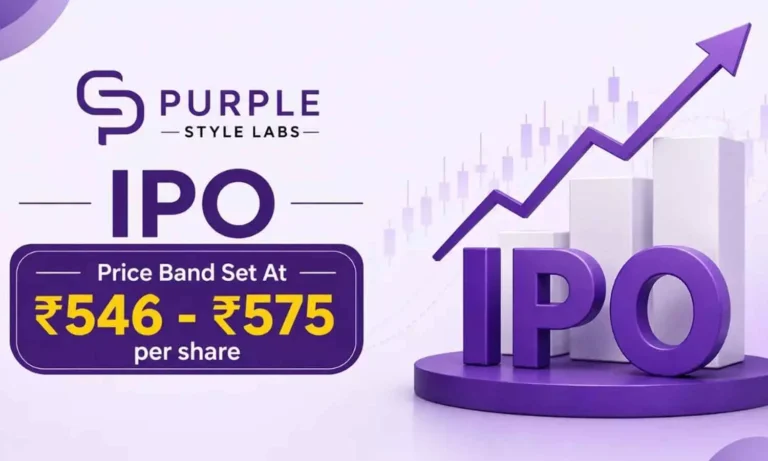
September 2026’s mainboard IPO calendar features data centre companies with 51% EBITDA margins and jewellery brands posting 56% ROE — and then there is Purple Style Labs IPO, which sits at the exact opposite end of that spectrum.
This is a luxury fashion platform that has reported net losses for three consecutive years, carries a negative book value, and reserves only 10% of its ₹680 crore issue for retail investors.
Understanding why this offering still drew institutional interest — and whether retail investors have a role here — is what this review decodes.
What Is Purple Style Labs and the Business Behind Pernia’s Pop-Up Shop
Purple Style Labs was founded in 2015 and is headquartered at Vile Parle East, Mumbai.
The company operates Pernia’s Pop-Up Shop (PPUS), a multi-brand luxury and designer fashion marketplace listing products from 1,312 active designer brands across women’s wear, men’s wear, jewellery, accessories, and kids’ wear.
Featured names on the platform include Seema Gujral, Anushree Reddy, Amit Aggarwal, and Rohit Gandhi & Rahul Khanna — a roster that anchors the brand’s credibility in India’s premium fashion segment.
Sales operate through an omnichannel model: the company’s website, mobile application, and physical Experience Centers spread across India.
In FY25, the platform registered 18.57 million unique visitors, 70,651 customers, and 104,856 orders across 100 countries.
Between FY23 and FY25, the company served over 200,000 unique customers across 140 countries — a global distribution footprint unusual for a domestic Indian luxury brand.
Promoter Abhishek Agarwal holds 28.26% pre-IPO, and no promoter sells shares through this issue.
Purple Style Labs IPO Date, Price Band, and Complete Subscription Details
The Purple Style Labs IPO opened for public subscription on August 31, 2026 and closes on September 2, 2026.
The confirmed price band is ₹546 to ₹575 per share, face value ₹10, with a lot size of 26 shares.
| Field | Details |
|---|---|
| Open / Close | August 31 – September 2, 2026 |
| Listing Date | September 7, 2026 (BSE + NSE) |
| Price Band | ₹546 – ₹575 per share |
| Issue Size | ₹680 Crore (100% Fresh Issue) |
| OFS | Nil |
| Lot Size | 26 shares |
| Retail Minimum | ₹14,950 (1 lot) |
| Retail Maximum | ₹1,94,350 (13 lots / 338 shares) |
| S-HNI Minimum | ₹2,09,300 (14 lots / 364 shares) |
| B-HNI Minimum | ₹10,01,650 (67 lots / 1,742 shares) |
| Allotment Date | September 3, 2026 |
| Demat Credit / Refunds | September 4, 2026 |
| Lead Managers | Axial Capital Pvt. Ltd.; IIFL Capital Services Ltd. |
| Registrar | KFin Technologies Ltd. |
| Promoter | Abhishek Agarwal (pre-IPO 28.26%) |
One figure demands immediate attention: the retail quota here is 10%, not the standard 35% on most mainboard IPOs.
QIBs receive 75% and NIIs receive 15% — retail investors compete for just ₹68 crore of a ₹680 crore offering, and this single structural fact shapes every allotment calculation and listing-day dynamic in this issue.
Where Does ₹680 Crore Go? Breaking Down the Objects of Issue
Every rupee of this ₹680 crore is a fresh issue — no OFS, no promoter exit, all capital stays with the company.
The deployment of those proceeds tells the most important story behind the Purple Style Labs IPO:
| Purpose | Amount (₹ Cr) |
|---|---|
| PSL Retail — lease liabilities for Experience Centers and back-end offices across India | ₹363.29 |
| Sales and marketing expenses | ₹128.00 |
| General Corporate Purpose | Balance |
₹363.29 crore — more than half the issue — funds lease liabilities for retail Experience Centers, not technology infrastructure or product development.
Another ₹128 crore goes to sales and marketing, an expense category that builds brand awareness but creates no tangible asset on the balance sheet.
This structure differs sharply from asset-creation IPOs: ESDS Software Solution deployed ₹576 crore into physical data centre hardware that generates revenue for decades; this issue finances occupancy costs and advertising spend.
The investment thesis requires believing that more Experience Centers and higher marketing spend will eventually push revenue past the cost break-even level — a burn-to-grow model common in consumer platforms but demanding in its required patience.
Investors tracking AI and digital commerce investment themes shaping India’s markets in 2026 will recognise this as a pre-profitability scaling play — legitimate, but requiring explicit risk tolerance.
Purple Style Labs IPO Financials: Revenue Recovered but Losses Have Tripled in Three Years

The financial record backing this offering is one of revenue volatility and rapidly accelerating net losses.
| Year | Revenue (₹ Cr) | Net Loss (₹ Cr) | PAT Margin | Assets (₹ Cr) |
|---|---|---|---|---|
| FY24 | ₹510.03 | ₹(47.71) | (9.35)% | ₹458.39 |
| FY25 | ₹494.00 | ₹(188.55) | (38.17)% | ₹497.05 |
| FY26 | ₹567.07 | ₹(285.40) | (50.33)% | ₹829.60 |
Revenue declined from ₹510.03 crore in FY24 to ₹494.00 crore in FY25 before recovering to ₹567.07 crore in FY26 — a two-year net revenue gain of 11.2%.
The losses did not stabilise: ₹47.71 crore → ₹188.55 crore → ₹285.40 crore — a nearly 6x increase in net loss while revenue grew 11%.
EBITDA margin at the operating level is 5.44% in FY26 — the business covers direct costs — but Experience Center depreciation, fitout amortisation, interest, and overhead push the bottom line deep negative.
EPS stands at ₹(41.98) and NAV per share is ₹(7.69) — negative book value means accumulated losses have fully eroded all shareholder equity.
ROCE is (23.56)%, RoNW carries no meaningful positive figure, and no P/E multiple is applicable — the standard financial ratios retail investors use to assess IPO value are all either negative or inapplicable here.
The core investor question: does FY26’s revenue recovery (+14.8% over FY25) mark the beginning of a scale inflection — or does each new Experience Center add to the cost base faster than it adds revenue?
Investors who applied to the Deepa Jewellers IPO this same season — a consumer brand with 56% ROE, 52% ROCE, and growing PAT — will find this financial contrast stark.
Purple Style Labs IPO Valuation: Pricing a Brand Bet With No Earnings and No Listed Peers
The Purple Style Labs IPO carries no applicable P/E multiple — negative EPS eliminates that framework — and the company explicitly states in the DRHP that no listed Indian peers exist for comparison.
Valuation must rely on revenue-based frameworks common for pre-profitability consumer platforms.
At ₹575 per share, the post-issue market cap is approximately ₹3,923 crore on FY26 revenue of ₹567.07 crore — an implied Price/Revenue multiple of ~6.9x.
Investor Allocation Structure — Purple Style Labs IPO vs Standard Mainboard
| Investor Category | This Issue | Typical Mainboard IPO |
|---|---|---|
| QIB (ex. Anchor) | 75% (~₹510 Cr) | 50% |
| NII / HNI | 15% (~₹102 Cr) | 15% |
| Retail (RII) | 10% (~₹68 Cr) | 35% |
The closest listed reference in Indian markets is Nykaa (FSN E-Commerce Ventures), which debuted in November 2021 as a loss-making fashion and beauty platform at 30–40x revenue at peak, then experienced significant post-listing price correction as the profitability timeline stretched.
At 6.9x revenue, the asking price here is not at Nykaa’s extreme peak multiple — but it requires investor conviction that losses will converge to zero on a timeline the DRHP does not explicitly map.
With QIBs holding 75% of shares, the listing price on September 7 will be driven almost entirely by institutional behaviour — not by retail demand or grey market sentiment.
Purple Style Labs IPO GMP Today: ₹28 Premium and What the Market Is Signalling
The current Grey Market Premium for the Purple Style Labs IPO stands at ₹28 per share.
At ₹575 (upper band) + ₹28 GMP, the implied listing price is approximately ₹603 — a ~4.9% premium over the issue price.
That 4.9% is the lowest grey market premium of September 2026’s mainboard batch: ESDS Software Solution carried ₹280+ GMP (~65%), Deepa Jewellers ₹46 (~26%), and Priority Jewels ₹45 (~25%).
The muted signal reflects HNI and dealer caution on a company with negative NAV and no earnings to anchor a price target — sophisticated informal market participants are not placing high-confidence bets here.
GMP is informal and unregulated; SEBI does not oversee grey market activity, and these numbers carry no predictive guarantee.
The most reliable listing signal will be QIB subscription rates, published in real time on NSE and BSE from August 31 — heavy QIB oversubscription could push GMP significantly higher before September 7, while weak QIB participation would further suppress it.
5 Risks Every Retail Investor Must Read Before the September 2 Close
These risks are specific, not generic — each one directly affects the probability of a profitable outcome.
Growing losses with no published break-even timeline: Net loss grew from ₹47.71 crore (FY24) to ₹285.40 crore (FY26), and the DRHP does not disclose a target quarter or fiscal year for profitability.
Negative book value (NAV ₹-7.69 per share): Investors pay ₹575 for shares in a company where accumulated losses have eroded all shareholder equity — no positive book value provides downside cushion.
Proceeds fund operating costs, not durable assets: ₹491.29 crore of ₹680 crore goes to lease liabilities and marketing — money that improves operations today but creates no collateral, IP, or infrastructure that holds residual value.
The retail quota of 10% makes meaningful allotment unlikely: With only ₹68 crore available for Retail Individual Investors, a 20x retail oversubscription leaves a 13-lot application worth ₹1,94,350 with approximately one lot (₹14,950) of allotment.
Luxury fashion demand concentration: India’s high-end designer fashion segment serves a narrow high-income demographic, and direct-to-consumer social commerce from the same designers on Instagram and WhatsApp creates platform disintermediation risk for Pernia’s Pop-Up Shop.
Practical Tips Before Applying for This IPO
These tips are issue-specific — not generic IPO advice.
Track QIB subscription by September 1 afternoon: QIBs control 75% of the issue; their subscription rate is the single most important signal for listing-day outcome — check the NSE and BSE India live subscription dashboards.
Model your actual allotment before deciding: At 10% retail quota and likely oversubscription, a full 13-lot application (₹1,94,350) may yield one lot (26 shares worth ~₹14,950 at cost) — factor that into position sizing.
Separate the brand story from the financial facts: This is a luxury market TAM and brand-value bet; applying requires a 5–7 year outlook on Indian designer fashion platform economics, not an assessment of current earnings ratios.
Do not use the GMP as a listing gain trigger: At 4.9%, the grey market premium provides minimal buffer — only a significant QIB oversubscription before September 2 close would create meaningful listing-day momentum.
Verify allotment from September 3 onwards at the KFin Technologies portal using PAN or application number.
Frequently Asked Questions
What is Purple Style Labs IPO GMP today? The Purple Style Labs IPO GMP stands at ₹28 per share, implying an estimated listing price of ~₹603 at the ₹575 upper band — a 4.9% premium over issue price. GMP is informal and unregulated; it does not predict the actual listing price on September 7.
When does the IPO close and when does listing happen? The subscription period closed on September 2, 2026. Allotment finalises on September 3, demat credit and refunds process on September 4, and listing on BSE and NSE is on September 7, 2026.
Can a retail investor realistically profit from applying here? With only 10% retail quota, allotment will be small even at maximum lots. The 4.9% GMP offers thin listing-day upside without strong QIB backing. For long-term investors with conviction in the luxury fashion platform story, the opportunity exists — but it requires a multi-year horizon, not a listing-day trade. Consult a SEBI-registered financial advisor before deciding.
How do I check my Purple Style Labs IPO allotment status? Allotment status is available from September 3, 2026 on the KFin Technologies registrar portal at ipostatus.kfintech.com — enter PAN or application number to check.
Why does this IPO reserve only 10% for retail investors? SEBI regulations permit QIB-heavy allocation structures under specific criteria — typically applied to pre-profitability companies where institutional due diligence provides the primary quality validation. The 10% retail ceiling signals this issue is structured primarily for institutional participation, with retail treated as a secondary constituency.
Losses Tripling, Revenue Recovering, GMP Modest — Purple Style Labs Has Made Its Ask, and Retail Investors Must Decide If They Believe the Story
The bull case is a brand argument: Pernia’s Pop-Up Shop has built a genuine luxury fashion platform with 1,312 designer partnerships, reach across 140 countries, and an omnichannel distribution model with physical Experience Centers.
The bear case is a financial statement: ₹285.40 crore in net losses in FY26, proceeds funding lease liabilities and marketing rather than scalable assets, negative NAV, and the lowest GMP of any September 2026 mainboard listing.
The 10% retail structure makes this primarily an institutional play — retail investors who apply follow the QIB decision, not a self-standing primary market thesis.
For long-term investors who believe India’s designer fashion segment will deliver platform-scale returns as the company achieves breakeven, this is an early-stage entry into a space with no listed comparables.
For investors who need positive earnings, a book-value floor, or near-term listing gains — the Purple Style Labs IPO financial profile at ₹575 per share does not provide those anchors, and September 7’s listing will reflect what institutional investors concluded, not what retail demand implied.
Disclaimer: This article is for informational and educational purposes only and does not constitute investment advice or a recommendation to buy or sell any securities. IPO investments are subject to market risks. This site is not SEBI registered. All financial data sourced from company filings and ipowatch.in. Readers are advised to consult a SEBI-registered financial advisor before making any investment decisions.