
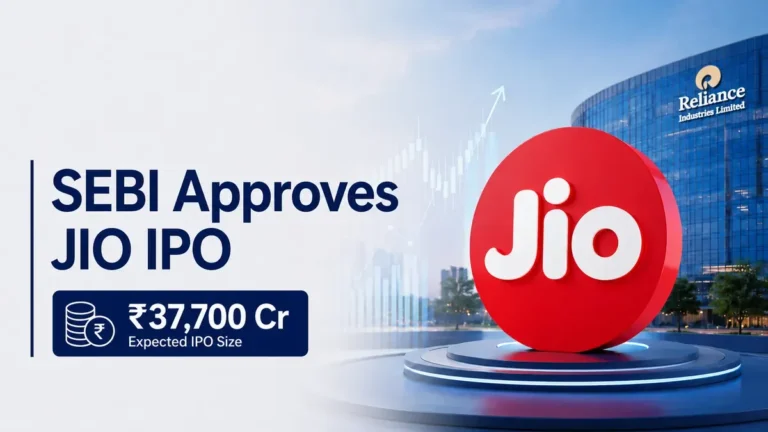
Jio Platforms IPO is the public market debut of Reliance Industries’ digital services subsidiary — the company that operates India’s largest 4G/5G telecom network, JioCloud, JioFibre, JioAI, JioTV, and a portfolio of digital platforms serving over 500 million subscribers.
With a DRHP filed with SEBI on June 19, 2026, and an estimated issue size of ₹37,700–₹40,000 crore, this debut offering is on course to become the largest IPO in Indian capital market history — nearly double the ₹20,557 crore raised by LIC in 2022.
Price band, open date, and lot size are not yet confirmed; this article decodes everything investors know from the DRHP, the financial disclosures, and the peer landscape.
What Is Jio Platforms and Why This IPO Rewrites India’s Capital Market Record Books
Jio Platforms Ltd is a wholly-owned subsidiary of Reliance Industries Ltd, incorporated to consolidate all of Mukesh Ambani’s digital and telecom assets under a single publicly listed entity.
Its subscriber base exceeds 500 million across India’s most widespread 4G/5G network — a scale that no other Indian telecom company has matched.
The digital portfolio extends well beyond connectivity: JioCloud, JioAI, JioFibre, JioTV, JioMart, and enterprise digital services collectively position the company as India’s integrated AI and digital infrastructure play.
The Jio Platforms IPO DRHP was formally announced by Mukesh Ambani at Reliance Industries’ 49th Annual General Meeting before being filed with SEBI on June 19, 2026.
At an estimated issue size of ₹37,700–₹40,000 crore, this offering would surpass the current record-holder — LIC’s ₹20,557 crore mainboard IPO from 2022 — by nearly 2x.
The sheer scale reframes the question for retail investors: this is not a stock-picking decision but a positioning decision on India’s digital infrastructure decade.
Jio Platforms IPO Date, Price Band, and Complete Issue Structure
The Jio Platforms IPO open date is yet to be officially confirmed — SEBI approval and the final Red Herring Prospectus (RHP) will lock in the exact subscription window, expected somewhere in the August–October 2026 period.
The issue involves 27,00,00,000 equity shares of face value ₹10 each, structured entirely as a fresh issue with zero OFS — meaning no promoter is selling a single share.
| Field | Details |
|---|---|
| Open / Close Date | TBA |
| Listing Date | TBA |
| Price Band | TBA (indicative ₹1,100–₹1,400 per share — unconfirmed) |
| Issue Size | ~₹37,700–₹40,000 Crore |
| Issue Type | 100% Fresh Issue |
| OFS | Nil |
| Lot Size | TBA |
| Listing Exchange | BSE + NSE (Mainboard) |
| Reservation | QIB 50% / NII 15% / Retail 35% |
| Lead Managers | 19 — incl. Kotak Mahindra Capital, Goldman Sachs, JP Morgan, Morgan Stanley, ICICI Securities, SBI Capital Markets, HDFC Bank |
| Registrar | KFin Technologies Ltd |
| Promoter (Reliance Industries) | Pre-IPO 66.43% → Post-IPO 64.48% |
With 19 lead managers — including Kotak Mahindra Capital, Goldman Sachs, JP Morgan, Morgan Stanley, ICICI Securities, SBI Capital Markets, HDFC Bank, Axis Capital, Jefferies, and JM Financial — this is the most syndicated IPO in Indian capital market history.
Investors should monitor the official RHP on BSE India for the confirmed price band and open date once SEBI grants final approval.
Where Does the ₹37,700 Crore Go? Decoding the Objects of Issue
Every rupee raised through the Jio Platforms IPO stays with the company — no OFS component means no promoter exit, which is structurally rare for a ₹37,700+ crore offering.
The primary use of proceeds is prepayment of outstanding borrowings of RJIL (Reliance Jio Infocomm Ltd.) — debt accumulated from 5G spectrum acquisition costs and national network rollout.
The secondary allocation goes toward general corporate purposes; the exact rupee split between the two heads will be disclosed in the final RHP once the price band is confirmed.
The distinction matters: debt repayment is a balance sheet improvement, not a capacity expansion — Reliance Jio’s 5G network is already built, and these proceeds clean up the liability side rather than add new infrastructure.
Unlike the LIC IPO — which was predominantly an OFS by the Government of India — the fresh issue structure here means every investor rupee strengthens the company’s own financial position.
Growth investors focused on JioAI and JioCloud expansion should monitor post-IPO capital allocation announcements from Reliance to assess how the company plans to fund its next growth phase independently.
Jio Platforms IPO Financials: ₹30,052 Crore PAT and What the Margin Trajectory Says
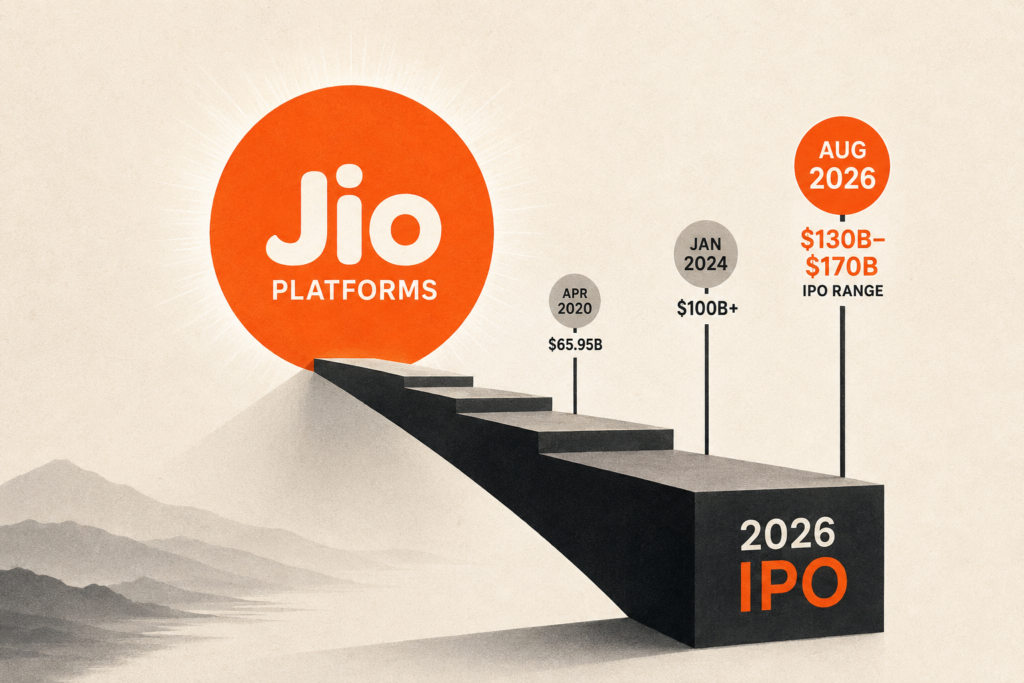
The Jio Platforms IPO is backed by one of India’s most consistently profitable businesses at scale, with PAT growing 40.2% over two years and EBITDA margin holding above 50%.
Revenue grew from ₹1,10,175.40 crore in FY24 to ₹1,49,759.10 crore in FY26 — a 35.9% increase over two fiscal years.
PAT tracked a steady expansion: ₹21,434.00 crore (FY24) → ₹26,120.30 crore (FY25) → ₹30,052.70 crore (FY26), with the PAT margin holding above 19% across all three years.
| Year | Revenue (₹ Cr) | PAT (₹ Cr) | PAT Margin | Assets (₹ Cr) |
|---|---|---|---|---|
| FY24 | ₹1,10,175.40 | ₹21,434.00 | 19.45% | ₹5,39,580.40 |
| FY25 | ₹1,29,333.00 | ₹26,120.30 | 20.20% | ₹5,81,233.80 |
| FY26 | ₹1,49,759.10 | ₹30,052.70 | 20.07% | ₹6,15,594.00 |
The EBITDA margin for FY26 stands at 51.91% — a figure that reflects the operating leverage of a network-effects business where each additional subscriber carries near-zero marginal infrastructure cost.
EPS (Basic) for FY26 is ₹33.63, NAV per share is ₹373.66, RoNW is 9.42%, and ROCE is 10.76%.
The 9.42% RoNW appears modest for a 51.91% EBITDA business — but the asset base of ₹6.15 lakh crore is enormous, diluting return ratios in a way that pure-margin analysis misses.
Investors evaluating the AI and cloud investment themes shaping India’s markets in 2026 will find Jio’s JioAI and JioCloud segments directly aligned with those macro tailwinds.
Jio Platforms IPO Valuation: How ₹1,300–₹1,400 Stacks Up Against Bharti Airtel
The Jio Platforms IPO price band remains unannounced — the analysis below applies the indicative ₹1,100–₹1,400 range circulating in media (unconfirmed) to disclosed FY26 financials.
At ₹1,400 per share on post-issue diluted EPS of ~₹32.63 (adjusted for 27 crore new shares), the implied P/E is approximately 42.9x.
At ₹1,300, the implied P/E drops to approximately 39.8x — still at parity with Bharti Airtel’s current 42.27x P/E multiple.
| Company | EPS (₹) | P/E Ratio | RoNW (%) | NAV (₹) | Revenue (₹ Cr) |
|---|---|---|---|---|---|
| Jio Platforms (IPO) | ₹33.63 | ~40–43x (indicative) | 9.42% | ₹373.66 | ₹1,49,759.10 |
| Bharti Airtel Ltd | ₹44.37 | 42.27x | 20.32% | ₹244.60 | ₹2,10,972.80 |
| Vodafone Idea Ltd | ₹3.21 | 4.65x | — | ₹(3.30) | ₹44,873.00 |
Airtel trades at 42.27x P/E with RoNW of 20.32% — Jio enters at parity P/E with lower equity returns, which means investors are paying a structural scarcity premium for the only integrated AI-telecom-cloud play going public in India.
Vodafone Idea’s negative NAV and speculative earnings make it a separate category entirely — the only meaningful listed benchmark for pricing this offering is Bharti Airtel.
The convergence risk is real: if digital segment margins in JioCloud and JioAI don’t accelerate post-listing, sustaining a 40–43x multiple purely on telecom ARPU growth becomes difficult.
Jio Platforms IPO GMP: No Formal Grey Market Yet — What the Unlisted Market Is Indicating
No formal grey market premium exists for the Jio Platforms IPO as of August 2026 — the issue is pre-open, and the price band has not been announced.
The unlisted pre-IPO market shows shares trading at approximately ₹1,250–₹1,275, reflecting early institutional and HNI demand sentiment, but this is an informal indication with no predictive weight on the actual listing price.
For comparison, the ESDS Software Solution IPO — another cloud infrastructure listing open this season — entered the grey market at a ₹280+ premium, signalling strong pre-listing appetite for India’s tech IPOs in 2026.
History cautions against extrapolating large IPO premiums into listing gains: LIC listed at a discount to issue price, and Hyundai India delivered muted listing gains despite strong oversubscription in 2024.
Once the price band is confirmed and the subscription opens, three signals will matter most: the quality of anchor investors listed in the allotment notice, QIB subscription rate by Day 2, and total HNI oversubscription multiples.
Formal GMP tracking will begin once the issue opens — investors can follow live GMP data on ipowatch.in and other grey market aggregators once subscription commences.
5 Risks in Jio Platforms IPO That Retail Investors Cannot Ignore
Before committing to the Jio Platforms IPO, retail investors should assess five structural risks that the strong headline numbers do not eliminate.
Valuation parity without return parity: Paying 40–43x P/E for 9.42% RoNW versus Airtel’s 20.32% RoNW leaves no margin of safety if telecom ARPU growth decelerates.
Regulatory dependence on TRAI and spectrum policy: Jio’s revenue trajectory is directly tied to TRAI decisions, AGR dues resolution, and government digital contract awards — any unfavourable policy shift compresses near-term visibility.
Debt repayment as the primary IPO object: The proceeds improve the balance sheet but do not add growth capacity — investors should independently assess post-IPO capex disclosures to understand how Reliance Jio funds network expansion after listing.
Post-listing float pressure from anchor lock-in expiry: A ₹37,700+ crore fresh issue creates substantial post-listing supply — institutional selling at the 30-day and 90-day anchor lock-in expiry windows can suppress the share price well beyond the listing date.
Undisclosed segment-level EBITDA for digital units: JioCloud, JioAI, and JioTV growth is cited in the DRHP but individual segment profitability is not separately disclosed — investors are pricing in AI and cloud upside they cannot independently validate from public filings.
Jio Platforms IPO Lot Size and How to Apply via ASBA or UPI
The Jio Platforms IPO lot size is not yet confirmed — it will be disclosed in the Red Herring Prospectus alongside the official price band.
Applications will open via ASBA through net banking or via UPI ID through broker platforms including Zerodha, Groww, Upstox, and AngelOne.
The UPI mandate limit of ₹5 lakh per application covers the full retail investment range, making UPI a viable application route for all retail investors once the lot size is announced.
This is a mainboard IPO, which means allotment for retail investors operates on a proportional basis — investors receive shares proportional to their application size relative to total retail demand, not through a lottery.
Applying the maximum permissible retail amount maximises the proportional allotment received — investors expecting high oversubscription should plan their full retail commitment rather than a single minimum-lot application.
Allotment status checks will be available at the KFin Technologies allotment portal once the basis of allotment is finalised.
The retail investor quota of 35% translates to approximately ₹13,195 crore of the ₹37,700 crore issue — the largest retail tranche ever made available in a single Indian IPO.
Frequently Asked Questions
What is the Jio Platforms IPO date? The Jio Platforms IPO date has not been officially confirmed as of August 2026. The DRHP was filed with SEBI on June 19, 2026, and the subscription window is expected between August and October 2026 — the exact open and close dates will be announced in the final RHP once SEBI grants approval.
Is the price band confirmed for this offering? No official price band has been announced. Media reports cite an indicative range of ₹1,100–₹1,400 per share, but these are unconfirmed market estimates. The confirmed price band will appear in the Red Herring Prospectus published on BSE India before the subscription opens.
How do I check the Jio Platforms IPO GMP today? There is no formal GMP yet, as the issue has not opened for subscription. Pre-IPO unlisted market indicators show shares at approximately ₹1,250–₹1,275 — these are informal and should not influence the application decision.
What makes this the largest IPO in India’s history? At 27 crore fresh equity shares and an estimated issue size of ₹37,700–₹40,000 crore, this offering exceeds LIC’s ₹20,557 crore record from 2022 by nearly 2x. The post-issue market capitalisation at indicative prices of ₹1,300–₹1,400 is estimated at ₹12–₹13 lakh crore (~$130–140 billion).
Should retail investors apply for this IPO? At indicative P/E of 40–43x on FY26 earnings, this is a long-term structural position in India’s AI, telecom, and cloud convergence story — not a listing-day flip trade. Retail investors should wait for the confirmed price band and RHP before making an application decision, and consult a SEBI-registered financial advisor.
₹37,700 Crore Fresh Issue, Zero Promoter Exit, and India’s Most Profitable Telecom — Jio Platforms Has Stated Its Terms
The numbers from the DRHP are unambiguous: ₹30,052.70 crore in net profit for FY26, 51.91% EBITDA margin, 500 million+ subscribers, and a 100% fresh issue structure that sends every rupee of capital to the company rather than to selling shareholders.
The proceeds go to RJIL debt prepayment — a balance sheet discipline move, not a growth capex deployment, which means the company’s future growth funding will require separate capital allocation decisions post-listing.
At indicative pricing of 40–43x P/E, the offering is priced at parity with Bharti Airtel despite lower equity returns — investors pay a structural scarcity premium for an asset that has no listed parallel in the Indian digital infrastructure space.
No confirmed price band, open date, or lot size exists yet — and retail investors should treat those confirmations as the actual investment decision trigger, not the DRHP filing.
For long-term portfolios aligned with India’s AI, cloud, and digital infrastructure decade — the Jio Platforms IPO, whenever it opens, will be a genuinely historic moment in Indian investing.
Disclaimer: This article is for informational and educational purposes only and does not constitute investment advice or a recommendation to buy or sell any securities. IPO investments are subject to market risks. All financial data sourced from company filings and ipowatch.in. Readers are advised to consult a SEBI-registered financial advisor before making any investment decisions.