

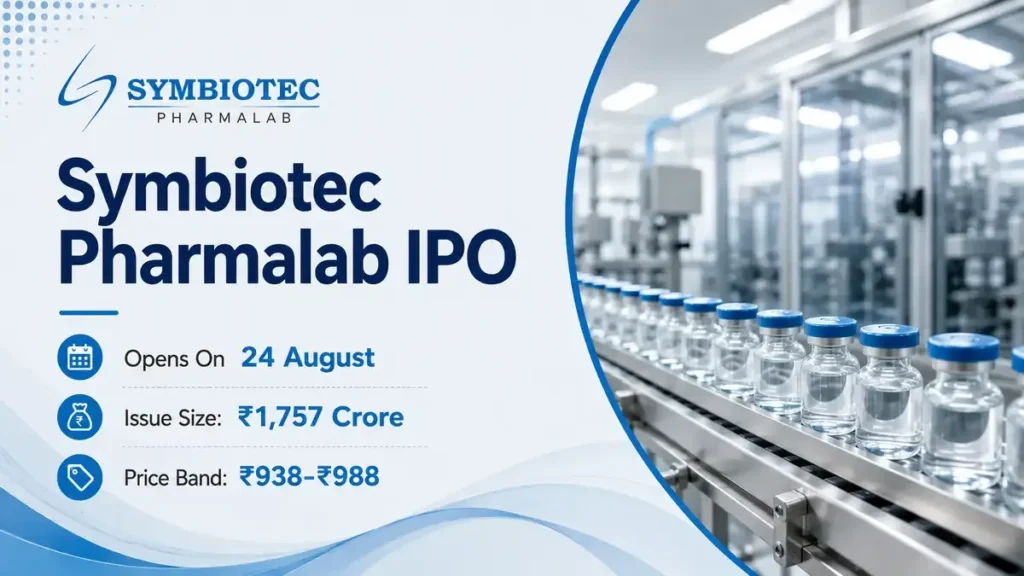
A retail investor scanning the August 2026 IPO pipeline in the third week of the month finds something different from the macro-heavy themes that dominated the past quarter: a mainboard pharmaceutical company with two consecutive years of improving revenue and profit, raising ₹1,757 crores at a price band of ₹938–₹988. The Symbiotec Pharmalab IPO opens on August 24 and closes on August 27 — three days to read the financials, evaluate the structure, and decide. Against a backdrop of RBI rupee defence measures, tariff-driven Nifty volatility, and a Nifty IT correction, a pharma IPO backed by real earnings offers a different investment thesis. This article covers every data point needed to evaluate that thesis: IPO dates, price band, issue structure, financial performance, allotment process, and five practical tips for retail applicants.
The Symbiotec Pharmalab IPO 2026 is a book-built mainboard issue. The company reported revenue of ₹872.26 crores and net profit of ₹109.90 crores in FY2026 — both figures improved year-on-year. ipowatch.in recommends applying for the long term. The question retail investors need to answer is whether ₹988 per share represents fair value for those earnings.
Symbiotec Pharmalab IPO Date — Every Applicant’s Critical Timeline
The Symbiotec Pharmalab IPO date schedule follows the standard mainboard timeline, but the three-day window carries operational implications that retail investors frequently underestimate.
August 24, 2026 — Subscription opens. The bidding window on BSE and NSE goes live. Retail Individual Investors (RII) can submit bids through their broker platform or directly through the bank’s ASBA/UPI channel.
August 27, 2026 — Subscription closes. The last day to submit a bid. UPI mandate approvals must be completed before the SEBI-mandated cut-off time on August 27. Banks processing UPI mandates can take up to 48 hours in high-traffic periods. Applicants who submit on August 27 risk mandate rejection if their bank’s processing queue is slow. The practical recommendation: apply on August 24 or August 25 and confirm the mandate approval notification before the close date.
August 28, 2026 — Allotment finalised. Symbiotec Pharmalab Limited’s registrar finalises allotment. Applicants can check status through the BSE allotment portal, NSE website, or the registrar’s portal using their PAN and application number.
September 1, 2026 — Listing on BSE and NSE. Shares begin trading simultaneously on both exchanges. The listing price is determined by the market’s opening order book — it may be above, at, or below ₹988.
This is a Mainboard IPO — not SME. The distinction matters: mainboard IPOs carry lower minimum investment requirements for RII applicants, use lottery allotment when oversubscribed in the retail category, and list on both BSE and NSE by default. An SME IPO lists only on the SME segment of BSE or NSE with different allotment rules and no retail lottery mechanism.
Symbiotec Pharmalab IPO Price Band and Issue Structure
Price band: ₹938 to ₹988 per share. Face value: ₹2 per share. Lot size: — (verify from ipowatch.in before applying).
Total issue size: ~₹1,757 crores, structured as two components:
- Fresh issue: ₹150 crores. Proceeds from the fresh issue go directly to Symbiotec Pharmalab Limited. The company intends to use this capital for stated purposes in the Red Herring Prospectus — typically capex, working capital, or debt repayment. This ₹150 crore component is the only capital that strengthens the company’s balance sheet through this IPO.
- Offer for Sale (OFS): Up to 1,62,65,181 equity shares. Proceeds from the OFS go entirely to the selling shareholders — promoters, early investors, or private equity — not to the company. At the upper band of ₹988, the OFS component translates to approximately ₹1,607 crores.
The fresh issue vs OFS split is a critical data point for long-term investors. When a ₹1,757 crore IPO has only ₹150 crores going to the company and the rest going to selling shareholders, the investment case depends entirely on the company’s existing business strength and future earnings trajectory — not on the IPO-raised capital transforming the business. Retail investors should check who the OFS sellers are (read Section II of the RHP) and what their original cost of acquisition was.
Allocation breakdown:
- QIB: 50% of the issue
- NII/HNI: 15% of the issue
- RII (Retail): 35% of the issue
The maximum RII investment is ₹2 lakh. Applications above ₹2 lakh shift the applicant into the NII category, where allotment is proportional (not lottery) and the minimum bid is typically 15+ lots.
Symbiotec Pharmalab IPO Review — Financials, Valuation, and What the Numbers Say
The Symbiotec Pharmalab IPO review starts with the only data that actually determines long-term investment value: the company’s financial performance.
Financial snapshot (source: ipowatch.in):
| Metric | FY2025 | FY2026 | YoY Growth |
|---|---|---|---|
| Revenue | ₹755.98 crores | ₹872.26 crores | +15.4% |
| Net Profit | ₹96.79 crores | ₹109.90 crores | +13.6% |
Both metrics improved year-on-year. Revenue grew 15.4% — above the typical 8–12% organic growth range for mid-size Indian pharmaceutical manufacturers, suggesting either new product launches, capacity additions, or export market gains. Net profit grew 13.6%, which is slightly below revenue growth — meaning operating leverage was modest rather than dramatic. The net profit margin for FY2026 works out to ₹109.90 Cr ÷ ₹872.26 Cr = approximately 12.6% — a healthy margin for a pharmaceutical manufacturer, where regulated generic manufacturers typically report 10–18% net margins depending on export mix.
Business context: Symbiotec Pharmalab Limited operates in pharmaceutical manufacturing. The company’s product mix, domestic vs international revenue split, and regulatory approvals (US FDA, EU GMP) determine the valuation multiple the market will assign. Companies with USFDA-approved facilities command P/E premiums over purely domestic manufacturers. The RHP, filed with SEBI, provides the complete breakdown of regulated versus unregulated market revenues.
IPO valuation: Post-issue P/E at ₹988 upper band requires the total post-issue shares outstanding — available from ipowatch.in or the RHP. At ₹109.90 crore FY2026 PAT, a P/E of 30x implies a market cap of approximately ₹3,297 crores; 40x implies ₹4,396 crores. Retail investors should compare the implied post-issue P/E against listed pharmaceutical peers: Sun Pharma trades at approximately 30–35x, Dr. Reddy’s at approximately 20–25x, and mid-cap pharma names in the ₹5,000–₹15,000 crore market cap range typically trade between 25–45x depending on growth visibility. If the Symbiotec Pharmalab IPO is priced at the lower end of this peer range, it offers reasonable value; at the upper end, it prices in significant future growth.
GMP (Grey Market Premium): — (verify from ipowatch.in on the day of application). GMP represents informal market sentiment about likely listing performance. A positive GMP does not guarantee a listing premium; a zero or negative GMP does not guarantee listing below issue price. Retail investors who apply solely based on GMP speculation rather than the underlying financial case make a category error in their decision process.
ipowatch.in recommendation: Apply for long term.
Symbiotec Pharmalab IPO Subscription Status — How Allotment Works Across Categories
The Symbiotec Pharmalab IPO allocates 35% of shares to retail investors, 15% to HNIs, and 50% to institutional buyers. The table below maps the key differences across all three investor categories.
| Parameter | RII (Retail) | NII / HNI | QIB |
|---|---|---|---|
| IPO allocation | 35% of total issue | 15% of total issue | 50% of total issue |
| Maximum investment | Up to ₹2 lakh | Above ₹2 lakh (no upper limit) | No upper limit |
| Application method | ASBA / UPI mandate | ASBA (bank mandate) | ASBA (bank mandate) |
| Allotment method if oversubscribed | Lottery — 1 lot per applicant | Proportional to bid size | Proportional to bid size |
| Minimum bid | 1 lot | Typically 15+ lots | Varies by institution |
| Cut-off price option | Available (recommended) | Not available | Not available |
| Fund unblock if not allotted | T+1 from allotment (August 29) | T+1 from allotment (August 29) | T+1 from allotment (August 29) |
T = Allotment date (August 28, 2026). All allotment norms subject to the final prospectus filed with SEBI. RII = Retail Individual Investor. NII = Non-Institutional Investor. QIB = Qualified Institutional Buyer.
How subscription data reads for retail investors: Live subscription figures for the Symbiotec Pharmalab IPO become available on BSE (https://www.bseindia.com) and NSE from August 24. QIB subscription above 5x by Day 2 typically signals institutional confidence in the business. RII subscription above 10x by Day 3 means allotment in the retail category will be via lottery at 1 lot per applicant — increasing lots applied does not increase allotment probability once the lottery threshold is crossed.
Cut-off price: Retail investors who select cut-off price (₹988) authorise their bank to block funds at the upper band and receive allotment at whatever final price the company announces within the band. This eliminates the risk of bid rejection from bidding at a lower price that falls outside the final issue price. All retail applicants should select cut-off price, not a specific bid within the band.
Symbiotec Pharmalab IPO Allotment Date and Listing — The Post-Subscription Playbook
Allotment — August 28, 2026
The registrar finalises allotment one day after the subscription closes. To check status:
- BSE allotment portal: https://www.bseindia.com/investors/appli_check.aspx
- NSE IPO allotment status: available on nseindia.com
- Registrar portal: — (confirm registrar name from ipowatch.in before article write)
Check requires PAN number and application number or demat account number. If allotted, shares transfer to the demat account before market open on September 1. If not allotted, the UPI mandate block releases automatically — funds return to the linked bank account without any manual action required.
Listing — September 1, 2026 on BSE and NSE
The listing price on September 1 reflects the market’s opening bid for Symbiotec Pharmalab Limited shares. Three scenarios:
- Listing above ₹988: Signals strong secondary market demand. Allotted investors face the hold-vs-sell decision. ipowatch.in recommends long term — which means the financial case justifies holding beyond the listing gain.
- Listing at or near ₹988: Flat listing. The IPO price held but generated no immediate gain. The investment case becomes purely about future earnings.
- Listing below ₹988: Weak listing. Allotted investors are temporarily underwater. The question is whether the business fundamentals — 15.4% revenue growth, 12.6% net margin — justify holding through a listing-day discount.
Unallotted investors can access Symbiotec Pharmalab Limited shares on the secondary market from September 1. If the listing price falls below ₹988, secondary market entry may offer a better entry point than the IPO price. For a broader framework on making post-IPO hold-vs-sell decisions within a long-term portfolio, the long term investment strategy guide covers position sizing and entry-point evaluation systematically.
5 Practical Tips for Applying to the Symbiotec Pharmalab IPO
1. Always select cut-off price — bidding below ₹988 risks rejection. Some retail investors bid at ₹938 (lower band) to reduce the funds blocked. If Symbiotec Pharmalab Limited sets its final issue price at ₹988, all bids below that level are automatically rejected. With one lot at stake, the difference in blocked funds between ₹938 and ₹988 per share is marginal — the allotment rejection risk is not. Select cut-off price on every mainboard IPO application.
2. Apply through direct bank ASBA on Day 1 or Day 2, not through a broker app on Day 3. Broker application platforms route UPI mandates through an additional processing layer, adding latency. Applying directly via the bank’s net banking or mobile banking ASBA interface reduces the processing chain. For a ₹988 upper band IPO closing August 27, mandate submission by August 25 gives two full days of processing buffer.
3. Understand the OFS scale before deciding on application size. The Symbiotec Pharmalab IPO raises ₹150 crores fresh and facilitates the exit of existing shareholders holding 1,62,65,181 shares via OFS. This means approximately 91.5% of the total capital raised flows to selling shareholders rather than the company. Retail investors should read the RHP’s section on selling shareholders: who is selling, at what price they originally invested, and how much equity they retain post-IPO. High promoter retention post-listing (above 50%) is generally a positive signal.
4. Watch the Nifty Pharma index between August 27 and September 1. The Nifty Pharma index captures sector-level sentiment that directly affects listing performance for pharmaceutical IPOs. A US FDA import alert on an Indian pharmaceutical manufacturer announced between subscription close and listing day, or an adverse drug pricing announcement, can depress the entire sector — including a freshly listed name regardless of its subscription level. Check the Nifty Pharma index direction on September 1 before making a listing-day sell decision.
5. Benchmark the P/E against sector peers, not just the GMP. The Symbiotec Pharmalab IPO review for long-term investors rests on whether ₹988 buys into the company at a reasonable earnings multiple. Sun Pharma at 30–35x P/E and Dr. Reddy’s at 20–25x P/E provide sector anchors. Where Symbiotec Pharmalab Limited’s post-issue P/E sits relative to these benchmarks — accounting for size, growth rate, and regulatory market exposure — determines whether the IPO is priced for value or priced for momentum. This peer comparison approach applies to any mainboard IPO across sectors, as demonstrated in the Lalithaa Jewellery IPO review.
Frequently Asked Questions — Symbiotec Pharmalab IPO
Q1. What are the open and close dates for the Symbiotec Pharmalab IPO? The Symbiotec Pharmalab IPO opens on August 24, 2026 and closes on August 27, 2026. The IPO runs for three subscription days. Retail investors applying through UPI should complete their bid by August 25 or 26 to allow sufficient time for UPI mandate approval before the August 27 close.
Q2. What is the price band, and how much does one lot cost? The price band is ₹938 to ₹988 per share, with a face value of ₹2. The lot size is — (verify from ipowatch.in). At the upper band of ₹988, the per-lot cost is approximately ₹[lot size × ₹988]. Retail investors can apply for a maximum of ₹2 lakh; applications above ₹2 lakh are classified under the NII category with proportional (not lottery) allotment.
Q3. When is the Symbiotec Pharmalab IPO allotment date, and how can applicants check? The Symbiotec Pharmalab IPO allotment date is August 28, 2026. Applicants can check their allotment status on the BSE investor services portal or NSE allotment page using PAN and application number. If not allotted, the UPI mandate block releases on August 28 or 29 and funds return automatically to the linked bank account.
Q4. On which exchanges does the IPO list, and when? The Symbiotec Pharmalab IPO listing date is September 1, 2026, with simultaneous listing on both BSE and NSE. The listing price is discovered through the opening order book on September 1 and may differ from the issue price of ₹988. Sector conditions, Nifty Pharma index direction, and overall market sentiment on September 1 all influence where the stock opens.
Q5. Does the Symbiotec Pharmalab IPO suit long-term investors? The financial case for the long term rests on FY2026 revenue of ₹872.26 crores (+15.4% YoY) and net profit of ₹109.90 crores (+13.6% YoY) at a 12.6% net margin. ipowatch.in recommends the IPO for long-term applicants. The key variables are the post-issue P/E relative to listed pharma peers, the company’s use of the ₹150 crore fresh issue capital, and its regulated-market export exposure. Retail investors should read the Red Herring Prospectus for the full product, geography, and customer concentration picture before applying.
Disclaimer
This article is published for educational and informational purposes only. All IPO data — dates, price band, issue size, allocation percentages, and financial figures — is sourced from ipowatch.in and publicly available filings as of August 2026. ipocontrol.in is not registered with SEBI as a research analyst or investment advisor. Nothing in this article constitutes investment advice, a buy or sell recommendation, or a solicitation to apply for any IPO. IPO investments carry market risk — allotment is not guaranteed, listing prices may be above or below the issue price, and past financial growth does not guarantee future performance. Verify all details from the Red Herring Prospectus filed with SEBI before making any investment decision. Consult a SEBI-registered financial advisor before applying.
The Price Band Closes on August 27 — The Real Evaluation Never Should
The Symbiotec Pharmalab IPO gives retail investors a three-day window to access a mainboard pharmaceutical company with consecutive years of revenue and profit growth. The financial numbers — ₹872.26 crores in revenue and ₹109.90 crores in net profit for FY2026 — are confirmed and improving. The issue structure, however, is weighted toward OFS: ₹150 crores fresh issue against approximately ₹1,607 crores in selling shareholder exits. That ratio does not make the IPO unattractive, but it places the long-term investment case squarely on the company’s existing earnings power and future growth trajectory, not on the IPO capital changing the business.
Retail investors who apply for the Symbiotec Pharmalab IPO at cut-off price, confirm their allotment on August 28, assess the Nifty Pharma index on September 1 before making a listing-day decision, and then evaluate the hold case against sector peers are treating this IPO as it deserves to be treated — as an entry into a business, not a three-day trading event. GMP moves in hours. Business fundamentals play out over quarters. The subscription window closes on August 27. The evaluation of whether to hold should run for years.