

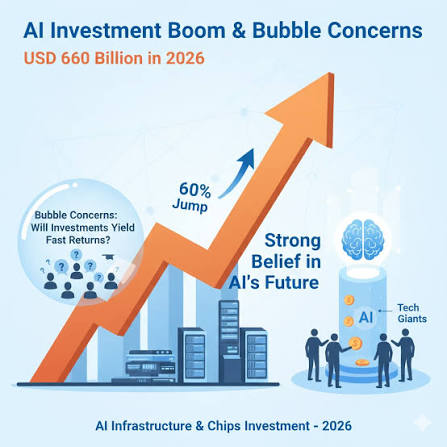
AI investment 2026 means exactly this: Microsoft, Amazon, Google, and Meta are collectively spending $725 billion on artificial intelligence infrastructure this year — up 77% from the already record-breaking $410 billion they spent in 2025. That is not a forecast. That is committed capital, already deployed or contractually locked in. For Indian retail investors deciding whether AI stocks belong in their portfolio, this number reframes the entire question. The debate is not whether artificial intelligence is real. The debate is whether markets have already priced in all the good news, leaving retail investors holding overvalued stocks as institutional money quietly rotates out.
The AI investment trends 2026 data tells two contradictory stories. Global tech spending has never been higher. At the same time, the Nifty IT index has fallen more than 40% from its December 2024 peak, the Nasdaq entered correction territory in August 2026, and South Korea’s Kospi — deeply tied to AI supply chains — dropped approximately 31% from its peak. Understanding which story applies to a specific portfolio position is the difference between capturing the AI opportunity and mistaking noise for signal.
What AI Investment 2026 Actually Looks Like — The Scale of Global Spending
The four largest technology companies on Earth are not spending $725 billion on a bet. They are buying specific hardware and infrastructure: Nvidia H200 and B200 GPU clusters, custom silicon (Google’s Tensor Processing Units, Amazon’s Trainium chips), AI-optimised data centres, and the high-bandwidth networking that connects them. Each dollar of capex is tied to a physical asset.
The revenue is real too. Microsoft Azure AI crossed a $37 billion annual run rate in 2026 — making it one of the fastest-growing enterprise software businesses in history. AWS AI services contribute directly to Amazon’s cloud division. Google’s AI-powered advertising tools and Google Cloud AI services drove measurable revenue growth through 2025 and into 2026. The Magnificent Seven as a group report net profit margins exceeding 25%, nearly double the S&P 500’s average of 13%. This is not the dot-com era, when companies spending lavishly on infrastructure had no path to profitability. Today’s AI infrastructure spenders have demonstrable earnings power.
The risk is not absence of revenue. The risk is concentration. The top 10 stocks in the S&P 500 now account for 35% of the entire index — above the 25% peak concentration recorded during the dot-com bubble of 2000. When a third of a major global index sits in 10 names, and those 10 names are all exposed to the same AI spending cycle, a correction in AI sentiment does not stay contained. It cascades through index funds, ETFs, and any portfolio with passive global exposure. Indian retail investors holding international index funds through SEBI-registered feeder funds carry more AI valuation risk than they typically calculate.
AI Stock Valuation Concerns — Are the Markets Pricing in Too Much?
The global AI trade peaked on approximately June 22, 2026, according to market data tracked by financial research platforms. In the weeks that followed, the Nasdaq Composite dropped 10.1% into correction territory. South Korea’s Kospi — among the most AI-supply-chain-sensitive indices globally, given Samsung and SK Hynix’s dominant roles in AI memory and chip packaging — fell approximately 31% from its peak. These are not rounding errors. They represent a genuine repricing of AI growth expectations at the institutional level.
The bull case remains intact on fundamentals. Meta’s operating margins held strong through mid-2026. Alphabet’s Google Cloud unit delivered revenue growth that beat consensus estimates. Microsoft Azure AI’s run rate is not a projection — it is invoiced revenue. The Magnificent Seven are not dot-com ghosts; they are cash-generating businesses.
The bear case is about timing and multiples, not the technology itself. Investor sentiment shifted when Meta raised capex guidance without proportional near-term revenue proof — the stock fell approximately 6% on that announcement. Markets began asking a harder question: when does $725 billion in AI infrastructure spending actually show up in per-share earnings? The payback horizon for AI data centres is typically 3 to 7 years. Stocks priced on 2029 and 2030 earnings projections carry duration risk every time interest rate expectations move. AI stock valuation concerns are not irrational — they are the rational response to the gap between capital invested today and revenue generated tomorrow.
AI Bubble Concerns 2026 — What the India-Specific Data Actually Shows
India’s experience with the AI theme in 2026 splits sharply depending on which part of the market an investor holds.
The Nifty IT index — dominated by TCS, Infosys, Wipro, HCL Technologies, and LTIMindtree — fell more than 40% from its December 2024 peak through mid-2026. That correction reflects a structural problem, not a cyclical one. Indian IT services companies built their business model on labour-arbitrage offshore development: cheaper skilled engineers, delivered at scale, to Western enterprise clients. Generative AI is disrupting that model from the demand side. Enterprise clients are using AI coding assistants, automated testing tools, and AI-driven documentation systems to reduce the headcount on software projects — and therefore reduce the volume of work routed to Indian outsourcing firms. TCS and Infosys are not AI beneficiaries in this environment. They are AI-disrupted incumbents, navigating a structural compression in their core revenue model.
The broader Indian market tells a different story. The Nifty 50’s price-to-earnings ratio stood at approximately 20.9 in early July 2026 — roughly 14% below its 10-year historical average. India, as an economy and a broad equity market, is not in bubble territory. Foreign Portfolio Investors (FPIs) bought a net $2.05 billion of Indian equities in July 2026, partly as capital rotated out of AI-overexposed global portfolios and into relatively cheaper emerging markets. That FPI inflow pattern is consistent with institutional de-risking of AI investment 2026 concentration, not with a collapse in India’s fundamental outlook.
The clearest illustration of this split: Netweb Technologies — an Indian company that manufactures AI servers and high-performance computing infrastructure for domestic enterprises — more than doubled in price during the same period the Nifty IT index was falling 40%. Infrastructure enablers and AI-disrupted services companies are two completely different bets wearing the same “AI” label.
Should Investors Invest in AI Stocks? — 5 Routes, 8 Parameters Compared
Indian retail investors have five distinct routes to AI exposure. The table below compares them across eight parameters to help investors match their risk profile to the right entry point.
| Parameter | Direct AI Stocks (US-listed) | Indian IT Services (TCS, Infosys, Wipro) | Indian AI-Infrastructure (Netweb, KPIT, Tata Elxsi) | AI-Themed Mutual Funds / ETFs | No AI Exposure (Dividend / Value Stocks) |
|---|---|---|---|---|---|
| AI upside capture | Very High | Low–Moderate | High | Moderate–High | None |
| Current valuation risk | High (elevated multiples) | Moderate (compressed post-correction) | High (recent run-up) | Moderate | Low |
| Currency risk for Indian investors | High (USD-INR exposure) | Low (INR-denominated) | Low (INR-denominated) | Moderate (fund-dependent) | None |
| Liquidity | High (US market hours) | Very High (NSE/BSE) | Moderate (lower float) | High (SEBI-regulated) | Very High (NSE/BSE) |
| Regulatory access | Requires LRS + international broker | Standard demat account | Standard demat account | Standard demat account | Standard demat account |
| Volatility | Very High | Moderate | High | Moderate | Low |
| Dividend income | Very Low (growth stocks) | Moderate (TCS, Infosys pay consistently) | Very Low | Low | High |
| Suitable for | Aggressive, 7+ year horizon | Moderate, 5+ year horizon | Aggressive, 5+ year horizon | Moderate–Aggressive | Conservative–Moderate |
LRS = Liberalised Remittance Scheme (RBI), allowing Indian residents to invest up to $250,000 per year in overseas securities. All assessments are qualitative, based on market data available as of August 2026.
AI Investment Risks for Investors — What the Data Doesn’t Tell You
The $725 billion in hyperscaler AI capex is the headline number. These five risks sit below it, and retail investors consistently underestimate them when constructing the artificial intelligence investment outlook.
Capex-to-revenue lag. AI data centres take 18–36 months to build and equip. GPU clusters require additional time to deploy in production applications. The $725 billion committed in 2026 will not produce proportional revenue until 2028–2030 at the earliest. Stocks priced on those future earnings face re-rating risk every time the timeline extends or interest rates move upward.
Passive index concentration. Indian investors holding international S&P 500 feeder funds or Nasdaq ETFs through NSE-listed ETFs carry more AI stock exposure than they realise. At 35% concentration in the top 10 names — all AI-adjacent — a 20% correction in the Magnificent Seven translates to a 7% index-level drawdown before any other sector moves. This is not theoretical risk; the Nasdaq’s 10.1% post-peak correction demonstrated exactly this mechanism.
India IT structural headwind. TCS, Infosys, and Wipro are not recovering from a cyclical revenue miss. They are adapting to a structural change in how their clients procure software development. This adjustment plays out over 5–10 years, not two quarters. Investors expecting these stocks to “bounce back” on the AI wave are misidentifying the direction of AI’s impact on India’s largest IT employers.
Geopolitical supply-chain risk. US export controls on advanced Nvidia GPU shipments to China reshaped the AI chip market without warning in 2022 and 2023. A similar policy shift targeting other geographies could affect Indian AI-infrastructure companies that source GPU hardware internationally. Netweb Technologies and comparable domestic AI infrastructure players carry hardware supply-chain risk that is rarely priced into their elevated multiples.
Monetisation timeline uncertainty. The market’s tolerance for “invest now, monetise later” narratives is narrowing. Meta’s 6% single-day drop on a capex increase announcement signals that institutional investors are applying more rigour to AI monetisation timelines than they did in 2022–2023. Retail investors entering AI stocks now bear the full brunt of that scrutiny risk.
5 Practical Tips for AI Investment 2026 — How to Position Without Overexposing
Retail investors approaching AI investment 2026 need a framework, not just a stock list. These five tips address the specific errors the current AI environment creates.
1. Split every AI holding into one of two buckets: infrastructure enabler or AI-disrupted incumbent. Before buying anything labelled “AI,” determine which side of the divide the company sits on. Nvidia, Netweb Technologies, and data centre operators sell picks and shovels to the AI gold rush. TCS, Infosys, and similar offshore IT services companies are having their business model disrupted by the same AI tools their clients are adopting. The investment thesis for each is not just different — it runs in opposite directions.
2. Use a SEBI-regulated AI-themed mutual fund for initial exposure rather than direct US stock picks. AI-themed international funds from AMCs like DSP, Mirae Asset, or Edelweiss provide rupee-denominated exposure to global AI stocks without requiring LRS filings, international brokerage accounts, or US tax form compliance. For investors building their first thematic allocation, this route eliminates regulatory and currency complexity. The how to invest ₹1 lakh guide covers how to structure the initial allocation between core and thematic positions.
3. Cap AI-themed holdings at 10–15% of total equity exposure. High-conviction thematic positions that exceed 15% of equity exposure introduce concentration risk that most retail portfolios cannot absorb. Investors under 35 with a 10-year horizon can hold the upper range. Investors over 45 with a 5-year or shorter horizon should stay closer to 5–10%. The AI theme does not guarantee above-market returns at any allocation size — position sizing is where risk is managed.
4. Do not confuse India IT index exposure with AI stock exposure. Holding a Nifty IT fund or buying TCS because of “AI tailwinds” conflates two entirely separate investment theses. Nifty IT is not an AI play — it is an AI-disruption-risk play. The companies that benefit most directly from AI infrastructure spending in India are smaller-cap and mid-cap: Netweb Technologies, KPIT Technologies, Tata Elxsi, Persistent Systems. These carry their own risks, but at least the thesis runs in the right direction.
5. Set a semi-annual review cadence — not a quarterly one. The AI investment cycle operates on multi-year monetisation timelines. Quarterly earnings misses in individual AI stocks are part of the cycle, not signals to exit the theme. Investors who react to short-term Nasdaq volatility by selling AI positions consistently re-enter at higher prices. The long term investment strategy framework provides a structured approach to periodic portfolio reviews that filter signal from noise.
Frequently Asked Questions — AI Investment 2026
Q1. Is AI investment in 2026 still worth pursuing for a retail investor with a 10-year horizon? Yes — but with significantly more selectivity than was required in 2022 or 2023. The structural case for AI investment 2026 is intact: $725 billion in hyperscaler capex, proven Azure and Google Cloud revenue, and expanding enterprise adoption across every sector. The easy first-mover returns are gone. Investors entering now face higher starting valuations and must identify specific AI sub-themes — infrastructure enablers, not AI-disrupted services — to position the thesis correctly.
Q2. Has the AI bubble already burst, or is this just a correction? A correction, not a burst. The Nasdaq dropped 10.1% after the global AI trade peak of June 22, 2026. The Nifty IT index fell 40%+ from its December 2024 peak. These are meaningful retracements, but the companies at the centre of the AI trade — Microsoft, Alphabet, Amazon, Meta — continue to generate real earnings and strong free cash flow. A bubble burst requires fundamental collapse, not valuation normalisation. What 2026 delivered was a reset from peak AI euphoria to more rigorous monetisation scrutiny.
Q3. How can Indian investors access global AI stocks without opening an international account? Three domestic routes work: (1) NSE/BSE-listed ETFs that track global technology indices or AI-specific baskets — available through any standard demat account; (2) international feeder mutual funds from SEBI-registered AMCs like Mirae Asset NYSE FANG+, DSP Global Innovation, or Edelweiss US Technology funds; (3) Indian-listed AI-infrastructure companies like Netweb Technologies, KPIT Technologies, or Tata Elxsi, which provide domestic AI exposure without currency or LRS complexity. Each route carries different risk profiles — the comparison table earlier in this article maps them.
Q4. Why did India’s Nifty IT fall so sharply if AI is supposed to be growing? Because India’s IT services sector sits on the disrupted side of the AI divide, not the beneficiary side. TCS, Infosys, Wipro, and HCL Technologies built their business on offshore software development delivered by large engineering teams. Generative AI tools — GitHub Copilot, Cursor, and similar AI coding assistants — reduce the developer headcount clients need to maintain software projects. Less headcount means fewer outsourcing contracts routed to Indian IT firms. The 40%+ Nifty IT fall reflects this structural demand compression, not a temporary project delay cycle.
Q5. What percentage of a portfolio should go into AI stocks in 2026? No fixed percentage fits every investor, but a commonly cited framework from financial planning practitioners sets a 10–15% cap on any single theme in an equity portfolio. For AI specifically, the high valuation multiples, capex-to-revenue lag risk, and index concentration effects make staying toward the lower end of that range prudent for most retail investors. Investors under 35 with 10+ year horizons can stretch to 15%. Investors over 45 or with near-term liquidity needs should stay at 5–10% or below.
Disclaimer
This article is published for educational and informational purposes only. All market data, capex figures, index performance, and company references are sourced from publicly available information as of August 2026, including CNBC, Statista, and financial research platforms. ipocontrol.in is not registered with SEBI as a research analyst or investment advisor. Nothing in this article constitutes investment advice, a buy or sell recommendation, or a solicitation to invest in any security. Equity and technology stock investments carry significant market risk. Past performance of AI-related indices does not guarantee future returns. Investors should conduct independent research and consult a SEBI-registered financial advisor before making any investment decision.
The AI Story Isn’t Over — But the Easy Money Might Be
The structural case for AI investment 2026 has not collapsed — $725 billion in committed hyperscaler capex, proven revenue from Azure AI and Google Cloud, and an expanding set of real enterprise use cases across healthcare, logistics, and financial services make the underlying technology adoption durable. That is not the debate.
The debate is about entry points, multiples, and which companies actually benefit. Retail investors who enter AI investment 2026 expecting the 2022–2023 style returns — when AI stocks were underpriced relative to their eventual impact — are entering a fundamentally different market. The Nifty IT correction, the Nasdaq’s post-peak pullback, and the $2.05 billion FPI rotation into Indian equities all reflect institutional investors redistributing AI exposure rather than uniformly bidding it up. The winners from this point will be investors who hold the right slice of AI — infrastructure enablers with real revenue, capped at a defensible allocation size, measured on a 7-year horizon — rather than investors chasing the headline number.