
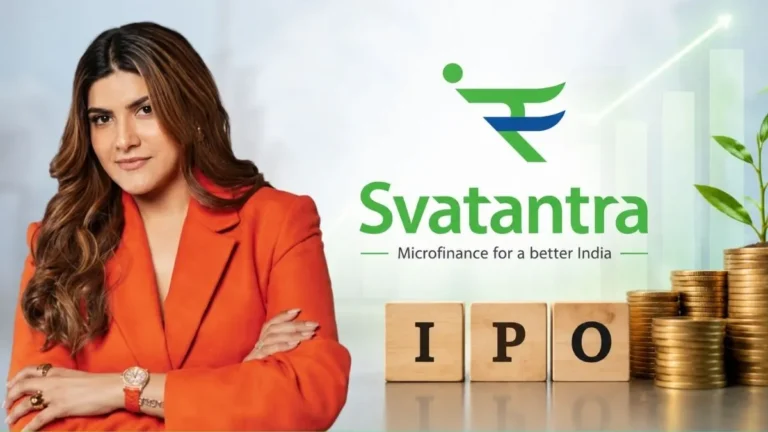
What does it take for a microfinance company serving over 35 lakh rural women borrowers across 19 Indian states to justify a mainboard IPO listing? And when that company is founded by Ananya Birla — daughter of Aditya Birla Group chairman Kumar Mangalam Birla — does the promoter’s profile strengthen the investment case or introduce a different set of expectations?
The Svatantra Microfin IPO is one of the more closely watched NBFC-MFI listings in recent years. This article covers every detail retail investors need before the subscription window opens — issue size, price band, GMP, financial performance, peer comparison, and a clear-eyed assessment of the risks specific to this sector and this issue.
Why the Svatantra Microfin IPO Is Attracting Attention in 2025
India’s microfinance sector has already produced a notable wave of mainboard listings. CreditAccess Grameen listed in 2018, Spandana Sphoorty in 2019, and Fusion Micro Finance in 2022. The Svatantra Microfin IPO enters this sequence as one of the later and larger NBFC-MFI entrants seeking primary market capital, having filed its DRHP with SEBI in late 2023.
The sector tailwind is real. India’s formal microfinance credit market crossed ₹3.5 lakh crore in outstanding portfolio (MFIN 2024 data), with roughly 60% of eligible low-income borrowers still unserved by formal channels — creating structural long-term growth potential.
The sector headwind is equally real. H2 FY2024 saw rising gross NPAs across the MFI universe, borrower overleveraging in Maharashtra, Karnataka, and Andhra Pradesh, and RBI’s tightened income assessment norms under the October 2022 Master Direction on NBFC-MFIs. The Svatantra Microfin IPO sits at the intersection of these competing forces — investors must evaluate both before applying.
About Svatantra Microfin — Company Background and Business Model
Ananya Birla founded Svatantra Microfin in 2012, starting with a single-state pilot in Maharashtra. The company operates as an NBFC-MFI under RBI classification, headquartered in Mumbai, Maharashtra.
The core business model is Joint Liability Group (JLG) lending — groups of 4–10 borrowers co-guarantee each other’s repayments. The primary product is income-generating loans (IGL) disbursed to rural and semi-urban women from economically weaker section (EWS) and low-income group (LIG) households. Average loan ticket size stays within RBI-mandated limits for NBFC-MFIs.
As of the DRHP filing, Svatantra Microfin operates across 19 states through 650+ branches, serving over 35 lakh active borrowers. The company’s AUM crossed ₹10,000 crore — placing it among the mid-to-large tier of India’s NBFC-MFI universe.
Ananya Birla holds the promoter stake in her individual capacity through her holding entity. The Aditya Birla Group as a corporate entity is not a promoter or guarantor of Svatantra Microfin’s financial obligations — a critical distinction investors must hold before associating group-level credit standing with this issue. PE investors including Advent International hold pre-IPO stakes and participate in the OFS component.
The company’s regulatory classification as an NBFC-MFI under RBI’s 2022 Master Direction means it must comply with borrower income thresholds, household debt caps, and lending rate ceilings that the RBI updates periodically.
Svatantra Microfin IPO Details — Date, Price Band, Lot Size, Issue Size, and GMP
The Svatantra Microfin IPO details that determine every retail application decision are consolidated below. Figures marked “-” are pending confirmation from the final Red Herring Prospectus — verify all parameters at sebi.gov.in before bidding.
| Parameter | Detail |
|---|---|
| IPO Open Date | – |
| IPO Close Date | – |
| Price Band | – |
| Lot Size | – |
| Minimum Retail Application (1 lot) | – |
| Maximum Retail Application (RII) | ₹2,00,000 |
| Total Issue Size | ~₹1,500 crore (Fresh Issue + OFS) |
| Fresh Issue Component | – |
| Offer for Sale (OFS) Component | Advent International and other PE investors |
| Listing Exchange | BSE and NSE (Mainboard) |
| Registrar | – |
| Allotment Date | – |
| Listing Date | – |
Issue size breakdown: The split between fresh issue and OFS is a material data point. Fresh issue proceeds go directly to Svatantra Microfin for Tier 1 capital augmentation — supporting loan book growth beyond ₹10,000 crore AUM. OFS proceeds go to selling shareholders. A predominantly OFS structure signals PE investors monetising exit rather than the company raising growth capital.
Reservation breakdown: Retail Individual Investors (RII): 35% | Non-Institutional Investors (NII/HNI): 15% | Qualified Institutional Buyers (QIB): 50% — confirm from RHP.
Svatantra Microfin IPO GMP: GMP at the time of writing is tracking at “-” — update from a verified grey market tracker at the time of application. GMP is unofficial and unregulated. For a full explanation of how grey market pricing works and what it can and cannot predict, see the grey market premium guide.
Svatantra Microfin Financial Performance — Revenue, Profit, AUM, and Asset Quality
Reviewing the Svatantra Microfin IPO’s financial performance across FY2022, FY2023, and FY2024 reveals whether the growth trajectory justifies the valuation being sought. Verified figures must be sourced from the RHP — cells marked “-” require confirmation.
| Metric | FY2022 | FY2023 | FY2024 |
|---|---|---|---|
| Total Revenue (₹ crore) | – | – | – |
| Net Interest Income (₹ crore) | – | – | – |
| PAT / Net Profit (₹ crore) | – | – | – |
| Gross NPA (%) | – | – | – |
| Net NPA (%) | – | – | – |
| AUM (₹ crore) | – | – | ~₹10,000+ |
| Return on Equity — ROE (%) | – | – | – |
| Return on Assets — ROA (%) | – | – | – |
| Capital Adequacy Ratio (%) | – | – | – |
What to look for in the numbers:
The industry-wide Gross NPA for NBFC-MFIs spiked to 10–12% during FY2021 post-COVID. The pace of normalisation from that peak to FY2024 varied widely — CreditAccess Grameen normalised fastest, Fusion Micro Finance more slowly. Svatantra Microfin’s NPA trajectory sits within this range; the specific path is visible in the DRHP.
Revenue CAGR should be assessed against AUM CAGR to confirm whether top-line growth reflects genuine book expansion or repricing effects. ROE relative to the 17–20% delivered by CreditAccess Grameen in FY2024 indicates whether Ananya Birla’s management team has built a capital-efficient credit franchise. Fresh issue proceeds earmarked for Tier 1 capital augmentation should be measured against the current CAR and credit portfolio growth targets disclosed in the DRHP.
Peer Comparison — Svatantra Microfin vs Listed MFI Competitors

Evaluating the Svatantra Microfin IPO valuation requires comparing it against listed microfinance and NBFC-MFI peers across the metrics that determine whether the issue price is reasonable or demanding.
| Company | AUM (₹ crore) | PAT (₹ crore) | ROE (%) | Gross NPA (%) | P/BV (×) | Status |
|---|---|---|---|---|---|---|
| Svatantra Microfin | ~₹10,000+ | – | – | – | – (at issue price) | IPO |
| CreditAccess Grameen | ~₹24,000+ | ~₹1,600+ | ~20%+ | ~1.5% | ~3.5× | NSE / BSE |
| Spandana Sphoorty | ~₹12,000+ | ~₹900+ | ~17%+ | ~2.0% | ~2.0× | NSE / BSE |
| Fusion Micro Finance | ~₹11,000+ | ~₹500+ | ~15%+ | ~3.5% | ~1.5× | NSE / BSE |
| Bandhan Bank (MFI segment) | Large (bank-level) | Large | ~12% | – | ~1.2× | NSE / BSE |
Peer figures are indicative based on FY2024 data. Verify all figures from company annual reports and the BSE filings at time of writing. Svatantra Microfin AUM is approximate — confirm from DRHP.
Reading the table: P/BV — Price-to-Book Value — is the standard valuation metric for NBFC-MFIs. P/E is less meaningful in this sector due to earnings volatility across credit cycles. CreditAccess Grameen at ~3.5× P/BV is the sector’s quality premium benchmark. Spandana Sphoorty at ~2.0× represents the mid-tier. Fusion at ~1.5× reflects elevated NPA risk pricing.
By AUM scale, Svatantra Microfin at ~₹10,000 crore is roughly comparable in size to Fusion Micro Finance and Spandana Sphoorty — placing it in the mid-tier of the listed MFI universe. Whether the IPO demands a CreditAccess Grameen-level premium or prices closer to the mid-tier range is the core valuation question retail investors must answer from the RHP.
IPO Valuation — Is Svatantra Microfin Fairly Priced?
The Svatantra Microfin IPO implies a post-issue P/BV that retail investors should calculate as: Issue Price ÷ Post-Issue Book Value Per Share (available in the RHP’s financial summary). The price band is not confirmed at the time of writing, so the exact P/BV cannot be computed here.
A valuation premium over listed peers is justified only if Svatantra Microfin delivers on at least two of three criteria: faster AUM CAGR than CreditAccess Grameen, lower Gross NPA than the peer median (~2.0%), or a higher ROE than Spandana Sphoorty’s FY2024 benchmark (~17%).
The OFS component adds another layer. When Advent International and other PE investors sell shares through the OFS, they crystallise returns on their original entry valuation — which is disclosed in the DRHP as cost of acquisition. Retail investors buying at IPO price fund that exit at whatever premium those investors have earned.
Ananya Birla’s promoter stake retention post-IPO is worth checking in the RHP. Material promoter holding post-issue signals founder confidence in the business trajectory. Significant dilution of promoter stake through the OFS would read differently.
Valuation verdict: Until the price band is confirmed and post-issue BV per share is disclosed in the RHP, a precise P/BV cannot be computed. Check CreditAccess Grameen’s live market P/BV on the day of application and compare it against Svatantra Microfin’s implied P/BV at the issue price — this single comparison is the most useful retail valuation check available.
Key Risks Every Investor Must Evaluate Before Applying
MFI sector credit stress. The Indian microfinance sector reported elevated NPA stress in H2 FY2024 across multiple players. Borrower overleveraging — taking simultaneous loans from 3–5 MFIs — drove NPA increases particularly in Maharashtra, Karnataka, and Tamil Nadu. Svatantra Microfin carries full exposure to these dynamics as an NBFC-MFI.
Geographical concentration. NBFC-MFIs concentrate their books in specific states. A large AUM share in 3–4 states exposes the entire portfolio to state-level political interventions, farmer debt relief announcements that spill into MFI collections, or weather-driven income disruptions. Andhra Pradesh and Telangana carry historical MFI disruption risk from the 2010 AP Microfinance Crisis.
Interest rate compression. NBFC-MFIs borrow from banks and bond markets to on-lend. When RBI holds rates elevated, the cost of borrowing rises faster than MFIs can reprice their loan books — compressing net interest margins.
Regulatory exposure. RBI revised MFI lending norms in October 2022, capping household debt obligations and mandating income assessment for each borrower. Any further tightening post-listing on borrower limits, rate caps, or reporting standards could restrict Svatantra Microfin’s disbursement growth.
Promoter name is not a guarantee. The Aditya Birla Group does not guarantee Svatantra Microfin’s obligations. Ananya Birla’s involvement adds public profile but not group-level financial backing. Evaluate the company on its standalone DRHP financials alone.
OFS exit risk. If the majority of the Svatantra Microfin IPO size is OFS, the company raises limited fresh Tier 1 capital. Growth plans tied to fresh issue proceeds deserve scrutiny if the fresh component is smaller than the OFS component.
How to Apply for the Svatantra Microfin IPO — Step by Step
Retail investors applying to the Svatantra Microfin IPO can choose between two application modes: ASBA (Application Supported by Blocked Amount) through net banking, or UPI-based application through broker platforms including Zerodha, Groww, Angel One, Upstox, HDFC Securities, and ICICI Direct.
UPI application flow: Open broker app → select the IPO → choose lot quantity → enter UPI ID → approve the mandate in the UPI app before the IPO closing time on the final day.
ASBA flow: Log in to net banking → navigate to IPO section → enter bid price and quantity → submit. The bank blocks — but does not debit — the bid amount until allotment.
Category: Applications up to ₹2,00,000 qualify under Retail Individual Investor (RII) and go through lottery allotment. Applications above ₹2 lakh fall under NII/HNI with proportional allotment.
Allotment process: If the RII category is oversubscribed, allotment runs via computerised lottery — each successful applicant receives 1 lot regardless of lots bid. For the complete application walkthrough, see the guide on how to apply for an IPO.
Allotment result: Published at the registrar’s website and at NSE’s allotment portal within 6 business days of IPO close. Track your result via IPO allotment status.
Tips — What Retail Investors Should Do Before Bidding
These Svatantra Microfin IPO-specific tips address the real decision points for retail investors considering this issue — not standard IPO checklists.
Tip 1: Download and read the DRHP Risk Factors section. The SEBI DRHP is publicly available at sebi.gov.in at zero cost. For an NBFC-MFI, the Risk Factors section typically discloses geographic concentration, NPA sensitivity, regulatory risk, and borrower-level default dynamics. Reading it takes 30 minutes and prevents a significant capital error for anyone who skips it.
Tip 2: Calculate the total ASBA block across concurrent IPO applications. At ₹2 lakh per application, retail investors applying to multiple open IPOs simultaneously must confirm their bank balance covers all active blocks. The bank blocks the full amount for the entire subscription period. Insufficient balance causes application rejection without notification in many broker platforms.
Tip 3: Test GMP against MFI sector listing history before treating it as a gain signal. CreditAccess Grameen listed in 2018 at a premium and then underperformed for 18+ months before earnings drove re-rating. Spandana Sphoorty listed in 2019 at a 6% premium and corrected within three months. GMP reflects grey market sentiment — not fundamental analysis — and the MFI sector has a track record of post-listing volatility that diverges from GMP signals.
Tip 4: Identify who is selling in the OFS and at what original entry valuation. The DRHP discloses the acquisition cost of each OFS seller. If a PE investor entered at ₹50/share and sells at ₹300/share via the OFS, the retail buyer absorbs that exit at a 6× markup. This is not automatically a reason to avoid applying — but it is context that belongs in the decision.
Tip 5: Compare the IPO’s implied P/BV against CreditAccess Grameen’s live market P/BV on application day. CreditAccess Grameen is the highest-quality listed NBFC-MFI benchmark. If the Svatantra Microfin IPO implies a P/BV equal to or higher than CreditAccess Grameen’s market P/BV on the day of application, the investor pays a listed-peer premium for an entity with less historical earnings track record as a public company.
FAQ — People Also Ask
What is the Svatantra Microfin IPO price band and lot size? The Svatantra Microfin IPO price band and lot size are pending confirmation in the final Red Herring Prospectus. The total issue size is approximately ₹1,500 crore. Retail investors can apply for a maximum of ₹2,00,000 under the RII category. Verify the exact price band, lot size, and minimum application amount from the official RHP at sebi.gov.in before placing a bid.
What is the Svatantra Microfin IPO GMP today? The current Svatantra Microfin IPO GMP is not confirmed at the time of writing — check a verified grey market tracker for the live figure on the day of application. GMP is an unofficial, unregulated indicator and not sanctioned by SEBI. It changes daily and does not reliably predict actual listing gains, particularly in the MFI sector where post-listing performance has historically diverged from GMP. A full explanation is at the grey market premium guide.
Who founded Svatantra Microfin and what is Ananya Birla’s role? Ananya Birla founded Svatantra Microfin in 2012 and serves as the company’s Managing Director. She is the promoter through her individual holding entity. The Aditya Birla Group — Kumar Mangalam Birla’s conglomerate — is not a corporate promoter or guarantor of Svatantra Microfin’s financial obligations. Investors who assume Birla Group’s corporate standing backs this IPO are making an incorrect assumption.
How can an investor check Svatantra Microfin IPO allotment status? Allotment results are published within 6 business days of the IPO closing date. Investors can check status at the registrar’s website (confirm name from RHP), at NSE’s allotment portal at nseindia.com, or at BSE’s IPO allotment section at bseindia.com. PAN number and application number are required for the lookup. The complete tracking process is at IPO allotment status.
Is the Svatantra Microfin IPO worth applying for? The Svatantra Microfin IPO review depends on two primary variables: the implied P/BV at issue price relative to listed peers, and the NPA trajectory in the RHP financials. If the issue prices below CreditAccess Grameen’s current market P/BV with a normalising NPA trend from the FY2021 peak, the risk-reward is reasonable for a 3–5 year investor. If P/BV meets or exceeds CreditAccess Grameen’s market multiple, the investor pays a premium for an unlisted entity in a sector with active credit stress — the margin of safety compresses considerably at that point.
Disclaimer
This article is for informational and educational purposes only. It does not constitute financial advice, an investment recommendation, or a solicitation to buy or sell any securities. ipocontrol.in is not registered with the Securities and Exchange Board of India (SEBI) as an investment adviser. All IPO details and financial figures must be verified against the official Red Herring Prospectus before applying. Peer comparison figures are indicative based on FY2024 public data. Investing in IPOs involves the risk of capital loss. Consult a SEBI-registered investment adviser before making any investment decision.
Strong Fundamentals, Real Risks — Apply With a Clear Head
The Svatantra Microfin IPO brings a scaled NBFC-MFI — with a recognisable founder, a 19-state rural lending presence serving 35+ lakh women borrowers, and an AUM that places it in the mid-to-large tier of the listed MFI universe — to the mainboard at a time when microfinance credit stress is a sector-wide reality.
For long-term investors with a 3–5 year horizon, the structural case for Indian microfinance is defensible: underpenetrated addressable market, RBI’s financial inclusion mandate, and a borrower base that has demonstrated strong repayment discipline when not overleveraged. If the issue prices at a discount to CreditAccess Grameen’s P/BV and the NPA trend normalises, the entry point is rational.
For retail investors seeking listing gains in a 2–3 day window, the MFI sector’s post-listing history warrants caution. GMP-implied premiums for MFI IPOs have frequently not held on listing day — particularly when sector-level credit stress is visible at the time of subscription.
The Svatantra Microfin IPO is not a blind name-association play — it is a sector-specific financial decision that rewards investors who read the DRHP, calculate P/BV against CreditAccess Grameen, and apply with a clear head rather than brand recognition.