
The Indian SME IPO segment recorded over 240 listings on NSE Emerge and BSE SME in FY2024–25, raising more than ₹8,400 crore — nearly 20% of the cumulative total raised since both platforms launched in 2012. That volume drew a significant wave of first-time retail investors into a market segment with fundamentally different rules from the mainboard. Several SME IPOs in FY2024–25 delivered listing-day gains of 100–200%, while others listed at discounts of 20–40% and continued declining in subsequent weeks.
Both segments use the same ASBA/UPI application process, the same allotment lottery, and the same demat account infrastructure. But the regulatory framework, eligibility thresholds, lot sizes, disclosure standards, and post-listing liquidity of mainboard IPO vs SME IPO differ at every level — and most retail investors do not understand those differences before applying.
Why the SME IPO Segment Has Attracted So Much Retail Attention
NSE Emerge and BSE SME launched in 2012 with a clear mandate: give smaller Indian companies access to public capital markets under a lighter regulatory framework. For the first several years, institutional interest was limited and retail participation stayed concentrated among experienced small-cap investors.
FY2022–25 changed the dynamic sharply. Combined SME platform listings have cumulatively raised over ₹40,000 crore since inception, with FY2024–25 alone contributing approximately ₹8,400 crore. Listing gains of 100–200% in heavily oversubscribed issues generated viral content across investor communities on X, YouTube, and Telegram — the allotment-and-listing cycle of profitable SME IPOs became a recurring social media format that reached retail audiences far beyond the traditional investor base.
SEBI’s 2024 investor behaviour study recorded a 4× increase in retail SME IPO participation over three years, with a significant proportion of new applicants from Tier 2 and Tier 3 cities with limited secondary market investing experience. The same mechanism that generated 200% listing gains in strong issues produced 40–60% post-listing declines in weaker ones within 3–6 months. The retail investor base absorbing those losses was largely unaware that the two market segments operate under structurally different regulatory frameworks, with different disclosure standards and fundamentally different post-listing liquidity profiles.
Mainboard IPO vs SME IPO — The Core Regulatory Difference
The most consequential difference between SME IPO and mainboard IPO is not the issue size — it is who reviews the offer document before investor funds are committed.
Mainboard IPO: SEBI directly reviews the DRHP under ICDR Regulations, 2018. The process takes 75–90 days from filing to listing. SEBI’s scrutiny covers financial disclosures, promoter background, completeness of risk factors, and stated use of proceeds. A minimum of 1,000 allottees must receive shares post-allotment. No mandatory market maker is required — the mainboard’s liquidity comes from its broad active secondary market participant base.
SME IPO: The DRHP is reviewed by the respective exchange — NSE Emerge or BSE SME — not by SEBI directly. The process completes in 30–50 days. Only 50 allottees are required. A mandatory SEBI-registered market maker must maintain continuous buy and sell quotes for 3 years post-listing to provide baseline liquidity.
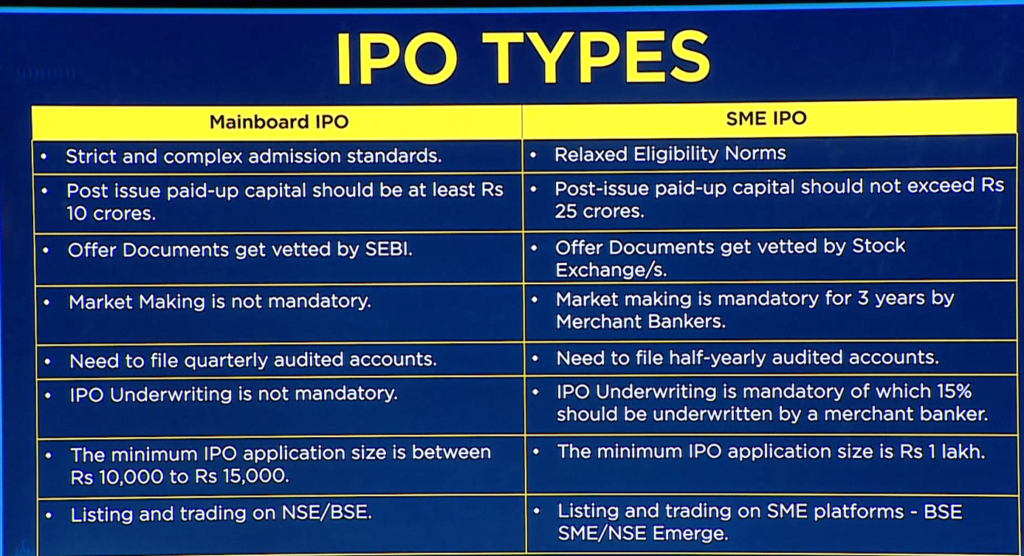
The difference between SME IPO and mainboard IPO in regulatory terms transfers significantly more due diligence responsibility to the individual retail investor. The detailed mainboard IPO vs SME IPO comparison across twelve parameters is in the table below.
What the Market Maker Requirement Actually Means for Retail Investors
SME IPO companies must appoint a SEBI-registered market maker who quotes buy and sell prices within ±2% of the last traded price, continuously, for 3 years post-listing. This provides technical liquidity — an investor can always find a quoted price — but it does not prevent price declines. The market maker is not obligated to absorb unlimited selling at the quoted price. In practice, retail investors who receive large allotments in oversubscribed SME IPOs frequently find the bid-ask spread wider than mainboard stocks, and selling any meaningful quantity in a single session can move the price against them.
Mainboard IPO vs SME IPO — Key Differences (2026)
| Parameter | Mainboard IPO | SME IPO |
|---|---|---|
| Exchange platform | NSE and/or BSE Mainboard | NSE Emerge or BSE SME |
| Regulatory oversight | SEBI reviews DRHP directly | Exchange reviews DRHP; SEBI framework applies |
| Min. post-issue paid-up capital | ₹10 crore minimum | ₹1 crore min; ₹25 crore maximum |
| Net tangible assets / track record | ₹3 crore NTA; 3-year operating history | 3-year history; lower financial thresholds |
| Minimum application lot size (RII) | ₹10,000–₹15,000 per lot | Minimum ₹1 lakh application value |
| Minimum allottees required | 1,000 | 50 |
| Market maker requirement | Not required | Mandatory for 3 years post-listing |
| Typical issue size | ₹250 crore to ₹27,000+ crore | ₹10 crore to ₹250 crore |
| SEBI direct DRHP scrutiny | Yes | No — exchange-processed |
| Migration to mainboard | N/A | Eligible after meeting mainboard norms |
| QIB allocation | 50% of issue | 15% of issue |
| Subscription category split | QIB 50%, NII 15%, RII 35% | QIB 15%, NII 15%, RII 35%, Market Maker 5% |
Source: SEBI ICDR Regulations, 2018; NSE Emerge and BSE SME listing guidelines.
Mainboard IPO Eligibility — What Companies Must Qualify
SEBI’s ICDR Regulations provide two routes for mainboard IPO eligibility.
Route I — Profitability track record: Companies must demonstrate net tangible assets of at least ₹3 crore in each of the 3 preceding years, average pre-tax operating profit of ₹15 crore in at least 3 of the 5 preceding years, net worth of at least ₹1 crore in each of the 3 preceding years, and paid-up capital of at least ₹10 crore post-issue.
Route II — QIB subscription route: For companies without the profitability track record — high-growth or loss-making businesses — the Route II path requires net tangible assets of ₹3 crore in each of the 3 preceding years, with at least 75% of the issue subscribed by QIBs (Qualified Institutional Buyers). No minimum operating profit requirement applies, but market capitalisation thresholds must be met.
The paid-up capital requirement captures the central eligibility difference in the mainboard IPO vs SME IPO framework: mainboard demands ₹10 crore post-issue minimum; SME IPOs require ₹1 crore minimum with a ₹25 crore cap. That ₹10 crore floor filters out the smallest, most financially vulnerable companies from the SEBI-supervised mainboard segment.
SME IPO Eligibility — What Companies List on NSE Emerge and BSE SME
SME IPO eligibility requirements include minimum paid-up capital of ₹1 crore, at least 3 years of operating history, positive net worth, and no winding-up orders. The financial thresholds are significantly lower than mainboard — intentionally so, to allow early-stage businesses to access public capital before reaching mainboard criteria. Because the exchange reviews the DRHP rather than SEBI, the process completes in 30–50 days. The speed comes at the cost of reduced regulatory scrutiny — and that trade-off is precisely what retail investors must account for before applying.
Lot Size and Minimum Investment — Why SME IPOs Cost More Per Application
The lot size difference between mainboard IPO vs SME IPO is the most immediate operational difference a retail investor encounters — and the one with the largest capital consequence per application.
Mainboard lot size: SEBI mandates the minimum application value for Retail Individual Investors (RII) in mainboard IPOs to fall between ₹10,000 and ₹15,000. A first-time applicant can participate in most mainboard issues with ₹10,000–₹15,000 in their ASBA-linked account, with UPI blocking the amount until allotment results are declared.
SME IPO lot size: SEBI’s SME framework requires a minimum application value of ₹1 lakh per lot — a deliberate policy choice, not a market convention. SEBI intended the higher capital threshold to attract more informed investors to a higher-risk segment. Lot sizes are fixed by the company at the issue price, and in practice range from ₹1 lakh to ₹2 lakh for a single-lot application.
The rupee consequence: A mainboard IPO listing at 30% below issue price costs the RII applicant ₹3,000–₹4,500 per lot. The same 30% discount on an SME IPO costs ₹30,000–₹60,000 per lot — a 10× capital loss differential for the same percentage decline. This asymmetry defines the practical risk difference in mainboard IPO vs SME IPO for the average retail participant, and it is the figure most relevant to any capital-at-risk calculation before applying.
SME IPO Risks — What Retail Investors Consistently Underestimate
The mainboard IPO vs SME IPO risk differential operates across five dimensions that retail investors routinely discount.
1. Regulatory disclosure risk. SEBI does not directly review the SME DRHP. Exchange review is less intensive than SEBI’s mainboard scrutiny, and historical instances of financial data restatements and undisclosed promoter-related transactions have occurred in the SME segment — risks that stricter mainboard norms reduce structurally.
2. Promoter exit risk. SME IPOs frequently carry large OFS components, with promoters holding 60–75% pre-IPO and exiting a significant portion at listing. After lock-in expiry — typically 1 year for SME promoter shares — a second wave of promoter selling can push the stock price below issue price within a compressed timeframe.
3. Post-listing liquidity risk. NSE Emerge and BSE SME stocks trade with a fraction of the daily volume of mainboard-listed equivalents. Many SME-listed stocks record fewer than 500 shares traded on a typical day, making exit at a fair price difficult for any retail investor who received a multi-lot allotment.
4. GMP distortion. SME IPO grey market premiums are more susceptible to manufactured demand than mainboard GMPs. A 100% GMP on a ₹15 crore SME IPO requires far less capital to engineer than a comparable GMP signal on a ₹1,000 crore mainboard issue — meaning the GMP signal is less reliable per rupee of GMP movement.
5. Which IPO is better for risk-averse investors. Mainboard IPOs from SEBI-scrutinised companies with ₹10 crore+ paid-up capital, diversified institutional subscription, and active secondary market depth carry structurally lower risk. SME IPOs suit investors with higher risk tolerance, sufficient capital to absorb an outright loss of the application amount, and the capacity to hold an illiquid position through a multi-year growth cycle.
SME IPO Listing — How These Stocks Trade After Debut
SME IPOs list on NSE Emerge or BSE SME — separate trading segments with separate stock symbols and circuit rules from the main NSE and BSE boards, operating on the same exchange infrastructure but with a materially smaller active trader base.
Price circuit limits: SME stocks operate with ±5% daily circuit filters. After allotment and listing, price movement through consecutive circuits over multiple trading days is common — making entry and exit a multi-day process rather than a same-session transaction. Investors who need to sell quickly post-listing may be unable to do so at a price that reflects the quoted bid without moving the price against themselves.
Listing norms and migration to mainboard: An SME-listed company meeting mainboard eligibility criteria — paid-up capital above ₹10 crore, profitability and net worth thresholds, minimum listing history of 2–3 years — can apply for migration to NSE or BSE mainboard. Migration requires exchange approval and a shareholder vote. Prudent Corporate Advisory migrated from BSE SME to BSE Mainboard in 2021; Dhanvarsha Finvest completed a similar migration, with liquidity improving significantly in both cases as the stocks became accessible to a broader institutional and retail investor base on the mainboard.
SME IPO Investment Guide — Five Tips Before Applying
These five criteria address the specific errors that consistently distinguish informed SME IPO applicants from those relying on GMP, subscription totals, and push notifications.
Tip 1: Read the DRHP — because the exchange did, not SEBI. For SME IPOs, the exchange rather than SEBI reviews the offer document. This makes independent DRHP reading more important in the SME segment than in mainboard applications. Four sections carry the most weight: Objects of the Issue (use of proceeds), Promoter Background (litigation history, group company structures, related-party transactions), Restated Financial Statements (3-year P&L and operating cash flow), and Risk Factors. The complete DRHP reading framework applicable to both mainboard IPO vs SME IPO applications is covered step by step in the how to analyse an IPO guide.
Tip 2: Check QIB subscription independently of total subscription. SME IPOs allocate only 15% of issue to QIBs, compared to 50% for mainboard issues. Lower QIB participation means less concentrated institutional due diligence behind the headline subscription number. An SME IPO oversubscribed 60× in the retail category with 0–1× QIB subscription signals retail momentum without institutional validation — a weaker quality indicator than the same retail subscription figure in a mainboard issue.
Tip 3: Discount GMP as a signal for SME IPOs. SME IPO grey market premiums require substantially less capital to manufacture than mainboard GMPs, given the smaller total issue size. A 100% GMP on a ₹15 crore SME IPO may reflect a grey market position of ₹1–3 crore — accessible to a handful of grey market operators with no reliable signal value for the retail investor.
Tip 4: Size the application against potential total loss — not gain. The minimum SME IPO application is ₹1–2 lakh. Before applying, the investor must determine whether a full write-off of that amount would materially affect their financial position. If it would, the capital allocation is too large for the risk profile — regardless of GMP level or oversubscription ratio.
Tip 5: Track promoter shareholding changes after lock-in expiry. Quarterly shareholding pattern filings on NSE Emerge and BSE SME disclose promoter holding changes. A sharply falling promoter stake in the quarters immediately following lock-in expiry is a well-documented precursor to sustained price pressure in SME-listed stocks. Retail investors holding SME shares through the lock-in expiry should monitor these filings — not the stock price alone.
Frequently Asked Questions
What is the difference between mainboard IPO vs SME IPO in India?
The core difference between mainboard IPO vs SME IPO lies in regulatory oversight, eligibility thresholds, minimum lot size, and post-listing liquidity. SEBI directly reviews mainboard DRHPs; the exchange (NSE Emerge or BSE SME) reviews SME DRHPs. Mainboard lot sizes require ₹10,000–₹15,000 minimum application value; SME lots require ₹1 lakh minimum. Mainboard companies must meet ₹10 crore post-issue paid-up capital; SME companies may list with as little as ₹1 crore. These structural differences determine the risk level an investor assumes from the day of application.
Are SME IPOs structurally riskier than mainboard IPOs?
Yes. SME IPOs carry higher risk across multiple dimensions: lighter SEBI disclosure scrutiny, smaller companies with shorter financial track records, lower post-listing liquidity, higher minimum capital per application, and greater GMP manipulation potential. That said, some SME-listed companies have grown materially and migrated to the mainboard — but the proportion that do within 5 years of listing is small relative to total SME listings. The elevated risk is structural, not incidental.
Which IPO is better for first-time retail investors?
Mainboard IPOs. Lower minimum lot size (₹10,000–₹15,000), direct SEBI scrutiny of the DRHP, more active secondary market trading, and 50% QIB allocation all reduce the risk of capital loss and improve the probability of a fair exit price post-listing. SME IPOs suit investors who have already applied to multiple mainboard IPOs, can read a DRHP independently, and can absorb or write off ₹1–2 lakh per application without affecting their overall financial plan.
Can the same demat account apply to both mainboard and SME IPOs?
Yes. The same demat account, ASBA-linked bank account, and UPI-registered number can apply to both mainboard and SME IPOs through any SEBI-registered broker or investment platform. The application mechanics and timeline are identical. The only operational difference is the UPI mandate amount — ₹1 lakh or more for SME IPOs versus ₹10,000–₹15,000 for most mainboard issues.
Can an SME-listed company move to the mainboard after listing?
Yes. SEBI permits migration once the company meets mainboard eligibility criteria — paid-up capital above ₹10 crore, the required profitability and net worth thresholds, and a minimum 2–3 year listing history. Migration requires exchange approval and a shareholder vote. Post-migration, the stock trades on the mainboard with improved liquidity, broader analyst coverage, and access to a larger institutional investor base.
Investment Disclaimer
The content in this article is for educational and informational purposes only. It does not constitute investment advice or a recommendation to apply for or avoid any specific IPO. ipocontrol.in is not registered with SEBI as an investment adviser. IPO investments carry market risk — read all offer documents carefully before applying. Past listing performance of any IPO is not indicative of future results. Consult a SEBI-registered investment adviser before making investment decisions.
Same Process, Different Rules
The application process for mainboard IPO vs SME IPO is identical in every mechanical respect — same UPI/ASBA mandate, same allotment lottery, same demat account, same refund timeline if allotment fails.
Everything else differs: the regulatory body that reviewed the company’s financials before listing, the financial thresholds the company had to meet to qualify, the minimum capital the investor risks per application, the depth of the secondary market they will face when trying to exit, and the level of scrutiny applied to the offer document they rely on to make an informed decision.
For first-time investors, the practical sequencing is clear: start with mainboard IPOs, where SEBI’s direct scrutiny reduces the documentation risk and ₹10,000–₹15,000 lot sizes keep the downside manageable; develop IPO analysis skills across 3–5 applications; then approach the SME segment with a full DRHP analysis framework already in place. The step-by-step DRHP checklist applicable to both segment types is available in the how to analyse an IPO guide.
Understanding the mainboard IPO vs SME IPO distinction does not make either segment automatically better or worse — it makes the investor a more informed allocator of capital across both.